Four Types of Faith
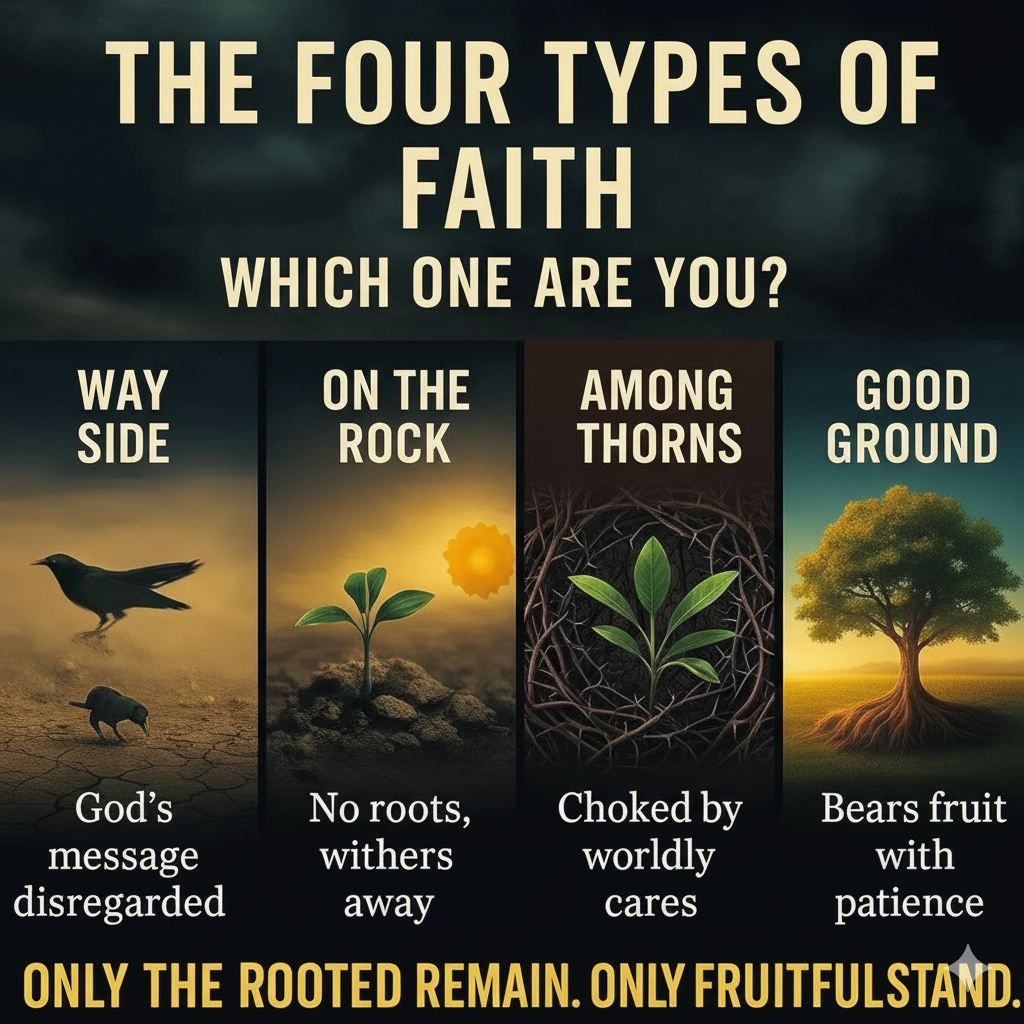
3. Hearken; Behold, there went out a sower to sow:
4. And it came to pass, as he sowed, some fell by the way side, and the fowls of the air came and devoured it up.
5. And some fell on stony ground, where it had not much earth; and immediately it sprang up, because it had no depth of earth:
6. But when the sun was up, it was scorched; and because it had no root, it withered away.
7. And some fell among thorns, and the thorns grew up, and choked it, and it yielded no fruit.
8. And other fell on good ground, and did yield fruit that sprang up and increased; and brought forth, some thirty, and some sixty, and some an hundred.
9. And he said unto them, He that hath ears to hear, let him hear.
10. And when he was alone, they that were about him with the twelve asked of him the parable.
11. And he said unto them, Unto you it is given to know the mystery of the kingdom of God: but unto them that are without, all these things are done in parables:
12. That seeing they may see, and not perceive; and hearing they may hear, and not understand; lest at any time they should be converted, and their sins should be forgiven them.
13. And he said unto them, Know ye not this parable? and how then will ye know all parables?
14. The sower soweth the word.
15. And these are they by the way side, where the word is sown; but when they have heard, Satan cometh immediately, and taketh away the word that was sown in their hearts.
16. And these are they likewise which are sown on stony ground; who, when they have heard the word, immediately receive it with gladness;
17. And have no root in themselves, and so endure but for a time: afterward, when affliction or persecution ariseth for the word’s sake, immediately they are offended.
18. And these are they which are sown among thorns; such as hear the word,
19. And the cares of this world, and the deceitfulness of riches, and the lusts of other things entering in, choke the word, and it becometh unfruitful.
20. And these are they which are sown on good ground; such as hear the word, and receive it, and bring forth fruit, some thirtyfold, some sixty, and some an hundred.
Mark 4:3–20 contains one of the Lord Jesus Christ’s foundational parables. Christ Himself interprets it, which gives us an inspired pattern for understanding His other parables. The central subject is the reception of the Word of God in the human heart. The sower is sowing one kind of seed, but that seed produces very different results because it falls upon different kinds of ground.
1. “Hearken; Behold” — The Command To Listen
Mark 4:3 “Hearken; Behold, there went out a sower to sow.”
Christ begins with two commands: “Hearken” and “Behold.” This is significant because the entire parable concerns hearing.
Later He says:
Mark 4:9 “He that hath ears to hear, let him hear.”
The problem is therefore not merely whether a person physically hears preaching. All four classes hear the Word. The difference is what happens after they hear it.
This agrees with:
James 1:22 “But be ye doers of the word, and not hearers only, deceiving your own selves.”
The sower goes forth deliberately to scatter seed.
Christ later identifies that seed plainly:
Mark 4:14 “The sower soweth the word.”
Therefore there is no need to speculate concerning the meaning of the seed. It represents the Word of God.
Compare:
Luke 8:11 “Now the parable is this: The seed is the word of God.”
The power is in the seed. The fundamental difference in the parable is the condition of the ground upon which it falls.
2. The Wayside Hearer
Mark 4:4 “And it came to pass, as he sowed, some fell by the way side, and the fowls of the air came and devoured it up.”
Christ explains:
Mark 4:15 “And these are they by the way side, where the word is sown; but when they have heard, Satan cometh immediately, and taketh away the word that was sown in their hearts.”
⚠ Notice carefully: the Word was sown in their hearts.
Their problem is not that they never encountered truth. They heard it, but the Word remained exposed upon the hardened surface.
A wayside was ground repeatedly walked upon until it became packed and hard. Spiritually, it pictures a heart upon which the Word makes no deep impression.
The immediate enemy is identified: “Satan cometh immediately.”
The fowls of verse 4 therefore picture Satan's activity in removing the Word.
Satan has always opposed God's Word.
In Genesis 3:1 his attack began: “Now the serpent was more subtil than any beast of the field which the LORD God had made. And he said unto the woman, Yea, hath God said, Ye shall not eat of every tree of the garden?"
His strategy remains connected with undermining, distorting, denying, or removing what God has spoken.
Paul similarly writes:
2 Corinthians 4:3–4 “But have renounced the hidden things of dishonesty, not walking in craftiness, nor handling the word of God deceitfully; but by manifestation of the truth commending ourselves to every man's conscience in the sight of God. But if our gospel be hid, it is hid to them that are lost: In whom the god of this world hath blinded the minds of them which believe not, lest the light of the glorious gospel of Christ, who is the image of God, should shine unto them.”
⚠ This first soil therefore represents the person who hears, but whose hardened heart provides no reception for the truth.
The sequence is: Word heard → no reception → Satan removes it.
3. The Stony-Ground Hearer
Mark 4:5–6 “And some fell on stony ground, where it had not much earth; and immediately it sprang up, because it had no depth of earth: But when the sun was up, it was scorched; and because it had no root, it withered away.”
Christ explains:
Mark 4:16–17 “And these are they likewise which are sown on stony ground; who, when they have heard the word, immediately receive it with gladness; And have no root in themselves, and so endure but for a time: afterward, when affliction or persecution ariseth for the word's sake, immediately they are offended.”
This hearer is dramatically different from the wayside hearer. The person does not reject the Word immediately.
Instead he:
- hears it,
- receives it,
- receives it “with gladness,”
- and appears to respond quickly.
Yet Christ identifies the fatal problem: “have no root in themselves.”
There is outward growth without inward depth.
The same word “immediately” appears twice in this portion. The Word is received quickly, but when trouble arises, the person also quickly falls away.
“afterward, when affliction or persecution ariseth for the word's sake, immediately they are offended.”
The trial does not create the lack of root. It reveals it.
The sun that scorches the shallow plant would actually assist a deeply rooted plant in its growth. Thus adversity exposes the true condition of the heart.
Christ said elsewhere:
John 15:20 “Remember the word that I said unto you, The servant is not greater than his lord. If they have persecuted me, they will also persecute you; if they have kept my saying, they will keep yours also.”
Paul likewise wrote:
2 Timothy 3:12 “Yea, and all that will live godly in Christ Jesus shall suffer persecution.”
Therefore genuine Christianity cannot be evaluated merely by emotional enthusiasm at the beginning.
A person may receive preaching joyfully, enjoy Christian fellowship, appreciate Christian teaching, and yet possess no spiritual root.
⚠ The test comes when obedience to the Word costs something.
4. “For The Word's Sake”
This phrase in verse 17 deserves special attention:
“And have no root in themselves, and so endure but for a time: afterward, when affliction or persecution ariseth for the word's sake, immediately they are offended.”
The persecution is specifically connected to the Word.
⚠ The stony-ground hearer is content with the Word while the Word is pleasant. He stumbles when loyalty to that Word produces suffering.
This recalls Christ's warning:
Matthew 10:33 “But whosoever shall deny me before men, him will I also deny before my Father which is in heaven.”
And:
John 8:31 “If ye continue in my word, then are ye my disciples indeed.”
⚠ Continuance is important evidence.
5. The Thorny-Ground Hearer
Mark 4:7 “And some fell among thorns, and the thorns grew up, and choked it, and it yielded no fruit.”
Christ gives an unusually detailed interpretation:
Mark 4:18–19 “And these are they which are sown among thorns; such as hear the word, And the cares of this world, and the deceitfulness of riches, and the lusts of other things entering in, choke the word, and it becometh unfruitful.”
Here the danger is neither immediate satanic removal nor persecution. It is competition. Christ identifies three competing influences.
The cares of this world
These are the anxieties, occupations, pressures, worries, and concerns connected with temporal life.
Christ warned:
Matthew 6:31 “Therefore take no thought, saying, What shall we eat? or, What shall we drink? or, Wherewithal shall we be clothed?”
And:
Matthew 6:33 “But seek ye first the kingdom of God, and his righteousness; and all these things shall be added unto you.”
Ordinary earthly concerns can become spiritually destructive when they dominate the heart.
The deceitfulness of riches
Christ does not merely say “riches.” He says: “the deceitfulness of riches.”
Money promises what it cannot ultimately provide: security, satisfaction, permanence, and independence.
Paul warns:
1 Timothy 6:9 “But they that will be rich fall into temptation and a snare, and into many foolish and hurtful lusts, which drown men in destruction and perdition.”
And:
1 Timothy 6:10 “For the love of money is the root of all evil: which while some coveted after, they have erred from the faith, and pierced themselves through with many sorrows.”
Riches deceive because they can make a person feel self-sufficient while spiritually impoverished.
Christ said:
Mark 8:36 “For what shall it profit a man, if he shall gain the whole world, and lose his own soul?”
“The lusts of other things”
This broad expression reaches beyond money. It includes desires for anything that enters the heart and rivals God's Word.
John describes this worldly pattern:
1 John 2:16 “For all that is in the world, the lust of the flesh, and the lust of the eyes, and the pride of life, is not of the Father, but is of the world.”
Notice the phrase in Mark: “entering in.” These influences do not necessarily overthrow the Word suddenly. They grow beside it until they “choke the word.”
This is spiritual suffocation.
6. “It Becometh Unfruitful”
This is the decisive description of the thorny-ground hearer. The person hears. There is growth of some kind. But there is ultimately: “no fruit.”
⚠ Throughout Scripture, fruit is associated with genuine spiritual life and obedience.
Christ said:
Matthew 7:20 “Wherefore by their fruits ye shall know them.”
And:
John 15:5 “I am the vine, ye are the branches: He that abideth in me, and I in him, the same bringeth forth much fruit: for without me ye can do nothing.”
Galatians identifies the character produced by the Spirit:
Galatians 5:22–23 “But the fruit of the Spirit is love, joy, peace, longsuffering, gentleness, goodness, faith, Meekness, temperance: against such there is no law.”
Thus the question is not merely: Did something spring up?
The decisive question is: Did it bring forth fruit?
7. The Good Ground
Mark 4:8 “And other fell on good ground, and did yield fruit that sprang up and increased; and brought forth, some thirty, and some sixty, and some an hundred.”
Christ explains:
Mark 4:20 “And these are they which are sown on good ground; such as hear the word, and receive it, and bring forth fruit, some thirtyfold, some sixty, and some an hundred.”
There are three principal actions: hear → receive → bring forth fruit.
That is the intended progress of God's Word in the receptive heart.
Luke's parallel adds:
Luke 8:15 “But that on the good ground are they, which in an honest and good heart, having heard the word, keep it, and bring forth fruit with patience.”
The good-ground hearer does not merely experience an emotional reaction. He keeps the Word and fruit follows.
8. Thirtyfold, Sixtyfold, & An Hundredfold
Mark 4:20 “some thirtyfold, some sixty, and some an hundred.”
Not every fruitful believer produces precisely the same quantity of fruit. There are differing measures of productivity.
But notice what every good-ground hearer has in common: fruit exists.
The distinction among them is not fruit versus no fruit, but differing degrees of fruitfulness.
Paul gives a related principle:
1 Corinthians 3:8 “Now he that planteth and he that watereth are one: and every man shall receive his own reward according to his own labour.”
And Jesus said:
John 15:8 “Herein is my Father glorified, that ye bear much fruit; so shall ye be my disciples.”
⚠ God therefore desires not merely initial reception of His Word but increasing fruitfulness.
9. The Mystery of The Kingdom of God
The disciples ask concerning the parable, and Christ says:
Mark 4:11 “Unto you it is given to know the mystery of the kingdom of God: but unto them that are without, all these things are done in parables.”
The word “mystery” in Scripture refers to truth once hidden but now revealed by God.
Understanding spiritual truth is therefore a divine privilege.
The disciples had responded to Christ and came to Him asking for understanding. Those “without” remained outside.
This distinction appears repeatedly in Scripture.
Paul says:
1 Corinthians 2:14 “But the natural man receiveth not the things of the Spirit of God: for they are foolishness unto him: neither can he know them, because they are spiritually discerned.”
And Christ says:
Matthew 11:25 “At that time Jesus answered and said, I thank thee, O Father, Lord of heaven and earth, because thou hast hid these things from the wise and prudent, and hast revealed them unto babes.”
Divine revelation must never produce pride. If a man understands God's truth, that understanding ultimately comes from God's gracious revelation.
10. “That Seeing They May See, & Not Perceive”
Mark 4:12 is one of the more solemn statements in the passage:
“That seeing they may see, and not perceive; and hearing they may hear, and not understand; lest at any time they should be converted, and their sins should be forgiven them.”
Christ is drawing from Isaiah 6.
Isaiah had been commanded to preach to a people who had repeatedly resisted God:
Isaiah 6:9 “Hear ye indeed, but understand not; and see ye indeed, but perceive not.”
The principle is that persistent rejection of divine truth can lead to judicial hardening.
God gives light, but men are responsible for what they do with that light.
Christ says elsewhere:
John 3:19 “And this is the condemnation, that light is come into the world, and men loved darkness rather than light, because their deeds were evil.”
Notice that their problem was not lack of light. Light came. They preferred darkness.
Romans 1 shows the same progression:
Romans 1:21 “Because that, when they knew God, they glorified him not as God, neither were thankful; but became vain in their imaginations, and their foolish heart was darkened.”
Then Scripture repeatedly says: “God gave them up.”
Therefore Mark 4:12 should not be understood as God arbitrarily preventing innocent people who desperately desire salvation from believing. Rather, it concerns people who are exposed to truth while remaining resistant to it. The same teaching which enlightens the receptive heart becomes judgment upon the hardened heart.
11. Why Did Jesus Teach In Parables?
Parables accomplished two functions simultaneously.
They revealed truth to receptive disciples and concealed truth from hardened hearers. The same parable was heard by everyone.
Yet the disciples came to Christ afterward:
Mark 4:10 “And when he was alone, they that were about him with the twelve asked of him the parable”
That is significant. They did not understand everything immediately either. The difference was that they asked.
This gives an important spiritual principle. Failure to understand everything immediately is not necessarily evidence of rejection. The proper response is to come to the Lord seeking greater understanding.
Compare:
James 1:5 “If any of you lack wisdom, let him ask of God, that giveth to all men liberally, and upbraideth not; and it shall be given him.”
12. “Know Ye Not This Parable? & How Then Will Ye Know All Parables?”
Mark 4:13
This statement shows the foundational importance of the parable.
Understanding the sower helps unlock other kingdom parables because it establishes recurring truths concerning:
- the Word of God,
- human hearts,
- Satanic opposition,
- temporary profession,
- worldly distraction,
- perseverance,
- and spiritual fruit.
⚠ It especially teaches that outward response alone cannot determine inward reality.
- One hears and immediately rejects.
- One hears and rejoices.
- One hears and grows for a while.
- One hears and bears fruit.
Yet only the final soil reaches the intended purpose of the seed.
13. One Seed, Four Soils
A crucial feature of this parable is that the seed never changes. The sower does not sow four different seeds.
This protects us from blaming God's Word when people respond differently to biblical preaching.
Isaiah says:
Isaiah 55:11 “So shall my word be that goeth forth out of my mouth: it shall not return unto me void, but it shall accomplish that which I please, and it shall prosper in the thing whereto I sent it.”
Peter describes God's Word as:
1 Peter 1:23 “Being born again, not of corruptible seed, but of incorruptible, by the word of God, which liveth and abideth for ever.”
The deficiency is not in the seed. The difference is in the soil.
Therefore the preacher's responsibility is not to invent a more entertaining seed. His responsibility is faithfully to sow “the word.”
Paul charged Timothy:
2 Timothy 4:2 “Preach the word; be instant in season, out of season; reprove, rebuke, exhort with all longsuffering and doctrine.”
14. Satan, The Flesh, & The World
The three unfruitful soils also reveal three great spiritual enemies.
The wayside: Satan takes away the Word.
The stony ground: affliction and persecution expose shallow profession.
The thorny ground: the world and its desires choke the Word.
These correspond broadly with recurring biblical enemies:
- the devil,
- the flesh,
- the world.
James 4:4 warns concerning friendship with the world. Galatians 5:17 speaks of the flesh lusting against the Spirit.
1 Peter 5:8 warns: “Be sober, be vigilant; because your adversary the devil, as a roaring lion, walketh about, seeking whom he may devour:”
⚠ The Christian life therefore involves continual spiritual conflict surrounding our response to God's Word.
15. The Passage Is A Warning Against Superficial Profession
One of the most sobering elements in this parable is that three groups hear the Word, and two of the unfruitful groups initially demonstrate some sort of response.
The stony-ground hearer even receives it: “with gladness.”
Therefore emotion by itself is not sufficient proof of conversion.
Jesus warned:
Matthew 7:21 “Not every one that saith unto me, Lord, Lord, shall enter into the kingdom of heaven; but he that doeth the will of my Father which is in heaven.”
The great scriptural evidence is perseverance accompanied by fruit.
Christ said:
John 8:31 “Then said Jesus to those Jews which believed on him, If ye continue in my word, then are ye my disciples indeed;”
16. Yet Fruitfulness Is Not The Ground of Salvation
An important distinction must be maintained. The Bible does not teach that a sinner earns salvation by producing sufficient fruit.
Salvation is by grace through faith.
Ephesians 2:8–9 “For by grace are ye saved through faith; and that not of yourselves: it is the gift of God: Not of works, lest any man should boast.”
But immediately afterward Scripture says:
Ephesians 2:10 “For we are his workmanship, created in Christ Jesus unto good works, which God hath before ordained that we should walk in them.”
⚠ Thus works do not purchase salvation; they follow God's saving work.
Fruit is not the price of life. Fruit is evidence that life is present. A living apple tree does not become alive because it bears apples. It bears apples because it is alive.
Likewise:
James 2:17 “Even so faith, if it hath not works, is dead, being alone.”
17. The Great Danger of A Divided Heart
The thorny soil deserves particular examination for professing Christians because the things choking the Word are not necessarily openly wicked things.
Christ mentions: “the cares of this world”
A person's work, finances, family responsibilities, possessions, ambitions, entertainment, reputation, and daily concerns can consume so much attention that there is little room for spiritual fruitfulness.
Christ warned Martha:
Luke 10:41–42 “And Jesus answered and said unto her, Martha, Martha, thou art careful and troubled about many things: But one thing is needful: and Mary hath chosen that good part, which shall not be taken away from her.”
The danger is not always openly rejecting Christ.
Sometimes the danger is allowing “many things” to crowd Him out.
18. The Progression of Spiritual Decline
Mark 4:19 gives a striking progression:
“And the cares of this world, and the deceitfulness of riches, and the lusts of other things entering in, choke the word, and it becometh unfruitful.”
Notice the stages:
- Things enter.
- Then they choke.
- Then the Word becomes unfruitful.
Spiritual barrenness often develops gradually.
Hebrews warns:
Hebrews 2:1 “Therefore we ought to give the more earnest heed to the things which we have heard, lest at any time we should let them slip.”
Neglect is spiritually dangerous.
19. The Repeated Emphasis Upon Hearing
Forms of “hear” occur repeatedly throughout this section.
- Verse 3: “Hearken.”
- Verse 9: “He that hath ears to hear, let him hear.”
- Verse 12: “hearing they may hear.”
- Verse 15: “when they have heard.”
- Verse 16: “when they have heard the word.”
- Verse 18: “such as hear the word.”
- Verse 20: “such as hear the word, and receive it.”
⚠ The great issue is therefore how one hears.
Luke's parallel records Christ saying:
Luke 8:18 “Take heed therefore how ye hear: for whosoever hath, to him shall be given; and whosoever hath not, from him shall be taken even that which he seemeth to have.”
Hearing Scripture is itself a spiritual responsibility.
20. A Personal Examination From The Four Soils
This parable should not merely cause us to classify other people. It should cause personal examination.
The appropriate questions are:
Wayside: Has repeated exposure to God's Word produced hardness rather than repentance?
Stony ground: Is my Christianity based primarily upon feelings and excitement, or is there spiritual root capable of enduring hardship?
Thorny ground: Are worldly cares, money, ambitions, pleasures, or desires slowly strangling spiritual fruitfulness?
Good ground: Am I hearing, receiving, keeping, obeying, and bearing fruit through God's Word?
Paul gives the appropriate command:
2 Corinthians 13:5 “Examine yourselves, whether ye be in the faith; prove your own selves. Know ye not your own selves, how that Jesus Christ is in you, except ye be reprobates?”
The Central Message of Mark 4:3–20
The parable may be summarized as follows:
| Ground | Reception of the Word | Main obstacle | Final result |
|---|---|---|---|
| Wayside | Heard but not received | Satan | Word removed |
| Stony | Immediately received with gladness | Affliction/persecution | Falls away |
| Thorny | Heard but crowded | Worldliness, riches, lusts | Unfruitful |
| Good | Heard and received | Perseveres | Fruit: 30, 60, 100 fold |
The first three demonstrate different ways the Word may fail to reach fruitfulness in a hearer's life.
Only the fourth completes the divinely intended process: hear → receive → fruit.
Conclusion
Mark 4:3–20 is ultimately a parable about the Word of God and the condition of the human heart.
The seed is good. The Word is living and powerful. The sower faithfully sows it. But people respond differently.
The hardened heart permits Satan to remove it.
The shallow heart receives it enthusiastically but cannot withstand opposition.
The crowded heart allows temporal concerns and desires to strangle its influence.
The good heart receives the Word, holds it fast, perseveres, and “bringeth forth fruit.”
The passage therefore concludes not merely with a lesson about ancient hearers, but with Christ's solemn appeal to every person exposed to Scripture:
“He that hath ears to hear, let him hear.”
The deepest question of the passage is not simply, “Have I heard the Word?” All four soils did.
⚠ The deeper question is: What is the Word of God producing in my heart and life?
Also see: