Trail of Blood
The Controversy Surrounding The Trail of Blood
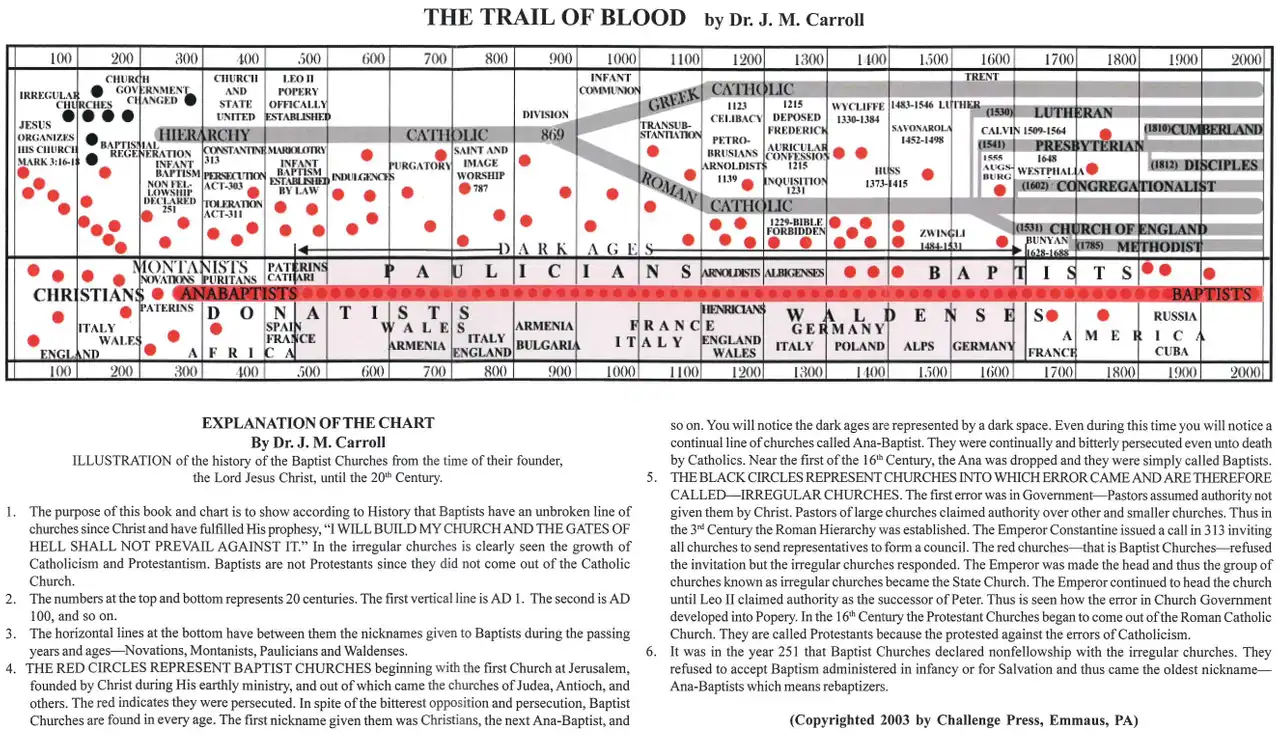
The Trail of Blood is a short Baptist-history booklet by J. M. Carroll, published in 1931 from a series of lectures. It argues that the churches established by Christ never disappeared and that a succession of faithful, Baptist-type congregations can be traced from the New Testament period through groups such as the Montanists, Novatians, Donatists, Paulicians, Albigenses, Waldenses and Anabaptists to modern Baptists. The “trail of blood” refers to the persecution endured by these dissenting Christians.
Carroll did not claim an apostolic succession of bishops like that asserted by Roman Catholic or Eastern Orthodox traditions. Instead, he claimed a continuing succession or perpetuity of local New Testament churches. He interpreted Matthew 16:18 and Matthew 28:20 as promises that Christ’s kind of church would remain present throughout every century.
1. The Central Historical Controversy
The main question is:
Is there sufficient historical evidence for an identifiable succession of Baptist churches from the time of Christ to the modern era?
Supporters answer yes, although the churches were not always called “Baptist.” Critics answer no: they argue that Carroll connected many unrelated movements simply because some of them opposed the established church, suffered persecution or appeared to share one or two Baptist principles.
The controversy is therefore not mainly about whether Christians were persecuted. Many unquestionably were. The disagreement concerns whether those persecuted groups can properly be called Baptists or Baptist ancestors.
2. Carroll Begins With Baptist “Marks”
Carroll first defines the marks of a New Testament church. These include:
-
Christ as its founder and head
-
Scripture as its rule of faith
-
Congregational government
-
A regenerate church membership
-
Believers’ baptism
-
Pastors and deacons as its officers
-
Independence of local congregations
-
Separation of church and state
-
Religious liberty
He then searches history for congregations or movements that appear to possess these characteristics.
Critics argue that this method risks circular reasoning:
-
Define the true church according to modern Baptist convictions.
-
Look backward for groups displaying some of those convictions.
-
Call those groups Baptists.
-
Use their existence to prove that Baptists have always existed.
This can demonstrate similarity, but similarity is not automatically historical descent.
3. The Problem of An Unbroken Chain
For an actual historical succession, historians normally look for evidence of transmission:
-
One congregation establishing another
-
Ministers being sent or ordained
-
Correspondence between churches
-
Confessions of faith
-
Membership records
-
Leaders identifying earlier communities as their predecessors
-
Evidence that doctrines and practices were consciously passed down
Carroll’s chart presents a continuous visual line, but the documentation does not establish every connection represented by that line.
The prevailing view among academic Baptist historians is that recognisably modern Baptist churches emerged in the seventeenth-century English Separatist and Puritan setting. Particular Baptists developed from English congregational and Puritan churches that came to embrace believers’ baptism, rather than from a demonstrable institutional chain stretching through every medieval dissenting movement.
This does not prove that nobody before the seventeenth century held Baptist-like beliefs. It means that a continuous organisational relationship has not been sufficiently demonstrated.
4. Combining Very Different Groups
Carroll treats names such as Montanists, Novatians, Donatists, Paulicians and Albigenses largely as hostile labels given to faithful dissenters by their enemies. He suggests that beneath these changing names was a continuing body of New Testament churches.
Historians object because these movements differed greatly from one another.
The Donatists
The Donatist controversy arose in fourth-century North Africa primarily over the purity of the church, the treatment of clergy who had compromised during persecution and the validity of sacraments administered by compromised ministers. It was not simply a movement of modern-style Baptist congregations practising Baptist doctrine.
The Cathars or Albigenses
The Cathars are generally associated with some form of theological dualism—the belief that the spiritual and material orders were governed by opposing principles. That is fundamentally different from orthodox Baptist belief in one sovereign Creator. Although the exact beliefs of every Cathar community remain debated, identifying the entire movement as Baptist is historically and theologically difficult.
The Paulicians
The historical evidence concerning the Paulicians is incomplete and often comes from hostile opponents. Nevertheless, their Christology, scriptural beliefs and religious practices are disputed enough that confidently calling them Baptists goes beyond the available evidence.
Carroll himself admits that not every persecuted group was fully loyal to New Testament teaching, though he believed that they were generally faithful.
This admission creates a problem: once groups with substantial doctrinal differences are included, it becomes unclear how much similarity is necessary before a movement qualifies as part of the Baptist succession.
5. Persecution Does Not Establish Identity
One of the booklet’s most powerful themes is that established churches and governments often persecuted religious dissenters. This is an important historical and moral lesson.
However:
Being persecuted does not by itself prove that a group was doctrinally correct or Baptist.
Catholics, Protestants, Anabaptists, Waldensians and many other communities experienced persecution at different times. Some persecuted other groups when they gained political power.
Carroll sometimes appears to divide history into two broad sides:
-
The established, persecuting Catholic or Protestant churches
-
The persecuted, faithful Baptist-type churches
Actual church history is more complicated. A movement could oppose ecclesiastical corruption and suffer unjust persecution while still holding doctrines that Baptists would reject.
6. The Use of Evidence Written By Enemies
Defenders of The Trail of Blood make an important point: much of what is known about medieval dissenters comes from church authorities and inquisitors who opposed them. Such writers could misunderstand, exaggerate or deliberately misrepresent the groups they condemned.
Consequently, accusations of heresy must be examined carefully. The destruction of dissidents’ writings also means that absence of surviving evidence does not always mean that a belief or congregation never existed.
But this argument has limits. Hostile sources should not be accepted uncritically, yet they cannot automatically be dismissed whenever they contradict the succession theory. Historical reconstruction must evaluate every source according to its date, purpose, independence and reliability.
A lack of evidence may make certainty impossible, but it cannot itself become positive proof that a hidden Baptist church existed.
7. The Landmark Baptist Connection
The booklet is closely connected to Landmarkism, a nineteenth-century Baptist movement emphasising:
-
The local church as the only proper visible church
-
Baptist church perpetuity or succession
-
The invalidity of non-Baptist baptism
-
Restrictions on communion
-
Refusal to recognise non-Baptist ministers or congregations as true churches
Under its strongest form, the theory does more than say that Baptist principles are biblical. It says that only churches within the historical Baptist succession possess proper church authority.
This produced serious controversy within Baptist life. The late nineteenth-century dispute involving Southern Baptist historian and seminary president William H. Whitsitt became especially intense when he rejected the theory that Baptist churches could be historically traced in an unbroken chain to the apostles. The controversy contributed to his eventual resignation.
Thus, The Trail of Blood is not merely about dates and historical names. It can affect practical questions such as:
-
Is a non-Baptist congregation a true church?
-
Is baptism valid only when administered by a properly authorised Baptist church?
-
May Baptist churches share communion or pulpits with other Christians?
-
Must a church possess historical succession to have legitimate authority?
8. The Theological Versus Historical Question
Two different claims are often confused.
Theological perpetuity
Christ has always preserved faithful believers and churches that maintained the gospel.
This is fundamentally a theological conviction based on biblical promises.
Documented Organisational Succession
There has been an identifiable chain of congregations, each historically connected to the next, from the Jerusalem church to modern Baptist churches.
This is a historical claim requiring documentary evidence.
A person may believe strongly that Christ preserved his church throughout history without believing that every link in an organisational Baptist chain can be identified. Matthew 16:18 may be understood as promising the preservation of Christ’s people and gospel rather than guaranteeing a traceable succession of congregations bearing modern Baptist distinctives.
9. What The Trail of Blood Gets Right
Despite its weaknesses, the booklet highlights several valuable truths:
-
The history of Christianity is not only the history of powerful institutions.
-
Numerous dissenting Christians suffered unjust persecution.
-
Church-state unions frequently produced coercion and violence.
-
Religious liberty should be defended for everyone.
-
Christian faithfulness does not depend on political recognition.
-
Baptist principles did not suddenly appear without any earlier parallels.
It also inspired many Baptists to take church history seriously and to appreciate the sacrifices of those who resisted forced religion.
10. A Balanced Conclusion
The Trail of Blood is best understood as a Baptist apologetic and identity booklet, not as a reliable stand-alone academic history.
Its strongest defensible claim is:
Throughout Christian history, communities and individuals repeatedly appeared who held certain convictions later associated with Baptists, such as voluntary faith, believers’ baptism, congregational independence and resistance to religious coercion.
Its weakest and most controversial claim is:
All the groups shown on the chart formed a continuous and identifiable succession of essentially Baptist churches from Christ to the present.
The first claim is historically reasonable. The second has not been adequately demonstrated.
Therefore, the booklet may be useful as an introduction to Baptist concerns about church purity, religious liberty and persecution, but its individual historical claims should be checked against detailed studies of each movement. It should not be treated as conclusive proof that modern Baptist churches possess an exclusive, unbroken institutional lineage from the apostles.
Also see: