Comma Johanneum
7. For there are three that bear record in heaven, the Father, the Word, and the Holy Ghost: and these three are one.
8. And there are three that bear witness in earth, the spirit, and the water, and the blood: and these three agree in one.
1 John 5:7 is famously known as the Comma Johanneum (Latin for "Johannine clause"). It is one of the most well-known textual differences in the New Testament.
To see the difference clearly, we have to look at 1 John 5:7 and 1 John 5:8 together, because the translations that exclude this clause combine the surrounding text.
Here is how the passage compares across different major translation families.
1. Translations That INCLUDE The Comma
These Bibles are based on the Textus Receptus (a Greek text compiled in the 1500s) or the Latin Vulgate. In these versions, the text includes an explicit reference to the Trinity.
-
King James Version (KJV)
"For there are three that bear record in heaven, the Father, the Word, and the Holy Ghost: and these three are one. And there are three that bear witness in earth, the Spirit, and the water, and the blood: and these three agree in one." 1 John 5:7-8
-
New King James Version (NKJV)
"For there are three that bear witness in heaven: the Father, the Word, and the Holy Spirit; and these three are one. And there are three that bear witness on earth: the Spirit, the water, and the blood; and these three agree as one." 1 John 5:7-8
-
Douay-Rheims (Catholic)
"And there are three who give testimony in heaven, the Father, the Word, and the Holy Ghost. And these three are one. And there are three that give testimony on earth: the spirit, and the water, and the blood: and these three are one." 1 John 5:7-8
2. Translations That EXCLUDE The Comma
Modern translations are based on "Critical Texts" (like the Nestle-Aland or United Bible Societies editions). These scholars rely on the oldest and earliest discovered Greek manuscripts. In these Bibles, the Trinitarian clause is absent from the main text (though usually noted in a footnote), making the passage much shorter.
-
English Standard Version (ESV)
"For there are three that testify: the Spirit and the water and the blood; and these three agree." 1 John 5:7-8
-
New International Version (NIV)
"For there are three that testify: the Spirit, the water and the blood; and the three are in agreement." 1 John 5:7-8
-
New American Standard Bible (NASB)
"For there are three that testify: the Spirit and the water and the blood; and the three are in agreement." 1 John 5:7-8
-
New Revised Standard Version (NRSV)
"There are three that testify: the Spirit and the water and the blood, and these three agree." 1 John 5:7-8
Why The Difference Exists
The discrepancy comes down to a difference in ancient manuscripts.
The Early Greek Manuscripts:
The explicit Trinitarian wording ("the Father, the Word, and the Holy Ghost...") is not found in any of the oldest Greek manuscripts of the New Testament. In fact, it doesn't appear in any Greek manuscript before the 14th century, except as a note scribbled in the margins. Because of this, modern translators overwhelmingly agree that the Apostle John did not originally write these words.
How It Got Into The Bible:
Historians believe the Comma Johanneum started as a "gloss" which is a marginal note written by a scribe in a Latin copy of the Bible hundreds of years after the text was originally authored. The scribe likely wrote it to explain that the "Spirit, water, and blood" were symbolic of the Trinity. Over time, later copyists mistakenly thought this margin note was part of the actual scripture and copied it directly into the main text of the Latin Vulgate.
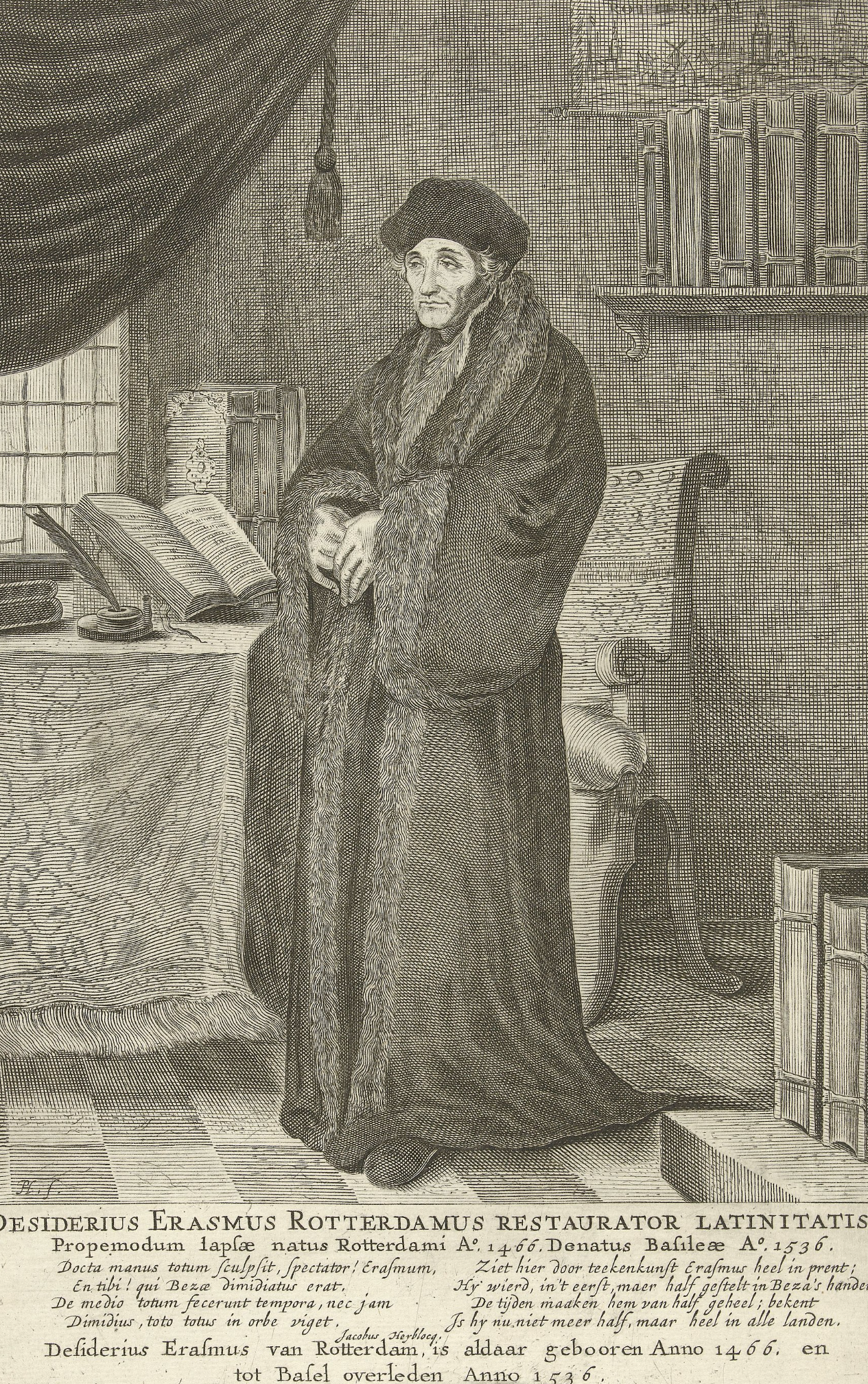
When Erasmus published the first Greek New Testament to reach the public in 1516, he omitted the Comma Johanneum from 1 John 5:7–8 because it was absent from the Greek manuscripts available to him. He also omitted it in his 1519 edition. After considerable theological criticism and after being shown a late Greek manuscript containing the passage, Erasmus included it in his third edition of 1522, although he expressed doubts about the manuscript. Erasmus's editions subsequently influenced those of Stephanus and Beza, creating the textual tradition later called the Textus Receptus. The 1611 King James translators relied especially on editions of Beza and other printed Greek texts belonging to this tradition, and consequently the Comma Johanneum appeared in the KJV.
Here is exactly how it happened:
✅ First and Second Editions: 1516 & 1519
Erasmus published his first Greek New Testament in 1516, and a revised edition in 1519. In both, he left out the Comma Johanneum. He noted that he simply translated what was in the Greek texts, none of which contained the Trinitarian verse.
✅ Fierce Backlash: 1519–1521
Erasmus faced intense fire from Catholic theologians, most notably Lopez de Zúñiga (Stunica) and Edward Lee. Because the verse was in the Latin Vulgate (the official Bible of the Church), they accused Erasmus of tampering with scripture and secretly promoting Arianism (the denial of the Trinity).
✅ The 'Discovered' Manuscript: 1522
To appease his critics, Erasmus included the verse in his third edition. His justification was that a single Greek manuscript containing the verse had finally been presented to him: Codex Montfortianus (also known as Minuscule 61).
✅ The King James Version: 1611
Subsequent publishers of the Greek New Testament—such as Robert Estienne (Stephanus) in 1550 and Theodore Beza in 1598—based their work on Erasmus's later editions. The 1611 King James translators relied heavily on Beza's Greek text, cementing the Comma Johanneum into the English Bible for centuries.
Conclusion
The Greek manuscript that became associated with Erasmus's decision—usually identified as Codex Montfortianus (Minuscule 61)—is itself an extremely late witness, dating from the sixteenth century. Some scholars have proposed that it was produced around 1520, possibly by or in connection with a Franciscan named Froy or Roy, and the famous suggestion that it was “made to order” to answer Erasmus's challenge has often been repeated in textual-critical literature.
However, deliberate forgery for this purpose cannot be demonstrated as a historical fact. What can be established is that Erasmus himself distrusted the manuscript's textual independence: he explicitly suspected that it had been revised according to Latin manuscripts. Nevertheless, after considerable criticism over his omission of the Comma Johanneum, he inserted the passage into his third Greek New Testament of 1522, explaining that he did so that his critics would have no further occasion to attack him. From Erasmus the passage entered later editions associated with the Textus Receptus and consequently appeared in the 1611 King James Version.
SCROLL - Undeniable Evidence for the Johannine Comma (1 John 5:7-8)
This video presents an argument defending the inclusion of the Johannine Comma (1 John 5:7-8) in the King James Bible. The speaker addresses the common criticism that this passage is absent from many Greek manuscripts, arguing that this exclusion is based on a reliance on a limited number of Alexandrian texts rather than the broader traditional text line.
Key points of the presentation include:
- Historical Evidence: The speaker provides an extensive list of early church fathers, ancient manuscripts, and historical confessions that either quote or allude to the verses. This includes references to figures like Tertullian, Cyprian, Athanasius, and Augustine, as well as citations from the Old Latin and various Vulgate manuscripts.
- Manuscript Context: The video disputes the claim that the verse was not part of the original writings by highlighting the limitations of current manuscript evidence and suggesting that early translations like the Waldensian Bibles support its legitimacy.
- Erasmus and Translation History: The video challenges myths surrounding Erasmus and his inclusion of the passage in his Greek New Testament editions, noting that figures such as Martin Luther, William Tyndale, and John Calvin maintained its inclusion in their respective translations.
- Numerical Patterns: The presentation concludes by highlighting alleged mathematical patterns within scripture, suggesting that the letter and vowel counts in the first and last verses of the Bible, in relation to 1 John 5:7, demonstrate divine influence and completeness.
Ultimately, the speaker concludes that the evidence from historical usage and the internal patterns of the text confirm that the Johannine Comma belongs in the Holy Scriptures.
Defense of I John 5:7 | Dr. Phil Stringer
In this sermon, Dr. Phil Stringer provides a defense for the inclusion of 1 John 5:7 (often referred to as the "Johannine Comma") in the King James Bible.
The Importance of 1 John 5:7
-
Explicit Trinitarian Proof: The verse ("For there are three that bear record in heaven, the Father, the Word, and the Holy Ghost: and these three are one") serves as a clear statement on the Trinity.
-
Doctrinal Defense: Dr. Stringer argues that retaining this verse refutes false doctrines and movements that deny the Trinity or the deity of Jesus Christ, such as Jehovah's Witnesses and Islam.
Historical and Manuscript Evidence
-
Latin Vulgate and Old Latin: The verse was included in Jerome's Latin Vulgate (around 400 AD) as well as the Old Latin (Itala) Bibles used by early, independent Christian groups long before the 16th century. Jerome noted that certain manuscript lines omitted the verse because early heretics removed it.
-
Church Fathers and Early Councils: Early church figures, including Cyprian (c. 250 AD) and Athanasius (300s AD), as well as the Council of Carthage (485 AD), cited or alluded to the trinitarian passage in their writings.
-
Greek Manuscripts: Contrary to claims that no Greek manuscripts contain the verse, historical scholars like John Gil documented multiple Greek minuscules containing or referencing the text.
Critique of Modern Textual Criticism
-
Scofield Reference Bible and Modern Translations: Dr. Stringer addresses common criticisms and footnotes in reference Bibles (like Scofield) and modern translations that call the verse spurious, attributing these dismissals to a reliance on minority Greek manuscripts.
-
Wescott and Hort: He argues that 19th-century textual critics wrongly prioritized corrupt or incomplete Alexandrian manuscripts over the majority tradition.
Personal Testimony and Conclusion
-
Faith in the KJV: Dr. Stringer shares his personal journey from initially doubting textual additions to adopting complete confidence in the King James Bible through detailed historical study (such as examining the ending of Mark).
-
Reliability of the KJV: He concludes that the King James Bible accurately preserves the word of God in English, and believers can confidently trust its textual integrity without relying on modern critical alterations.
Also see: