Jesus' Parables
A Theological & Historical Analysis of Jesus' Parables
Introduction
The parables of Jesus, often presented in modern contexts as simple moral tales or comforting allegories, were in their original setting something far more potent: disruptive narratives designed to confront, subvert, and radically reframe the listener's entire worldview. They were not gentle fables meant to reinforce existing ethical systems but sharp-edged tools crafted to shatter them. The power of these stories lies not in their timeless platitudes but in their radical particularity, rooted deeply in the complex soil of first-century Judean society. To hear them as their first audience did is to experience a profound intellectual and spiritual disorientation, a "shock value" that is the very key to their intended meaning.
This is a comprehensive analysis of eleven of these pivotal narratives. The methodology employed moves beyond surface-level moralisms to conduct a deep-dive into the historical-critical context of each parable. By examining the specific social, cultural, economic, and religious dynamics at play, this analysis seeks to unlock the radical theological claims Jesus makes about the nature of God, the meaning of justice, the scandal of grace, and the constitution of true community. The parables, when read in this light, cease to be predictable stories and become what they were always meant to be: invitations into an "upside-down kingdom" where the logics of human power, merit, and exclusion are inverted. They are carefully constructed arguments, often delivered in response to specific challenges, that function to dismantle the theological and social certainties of their hearers. This report will deconstruct each parable, exploring its original context to reveal the challenging and often unsettling vision of reality it proposes, a reality where God's mercy consistently defies human expectation and where true righteousness is found in the most unexpected places.
Part I: Parables of Social & Religious Confrontation
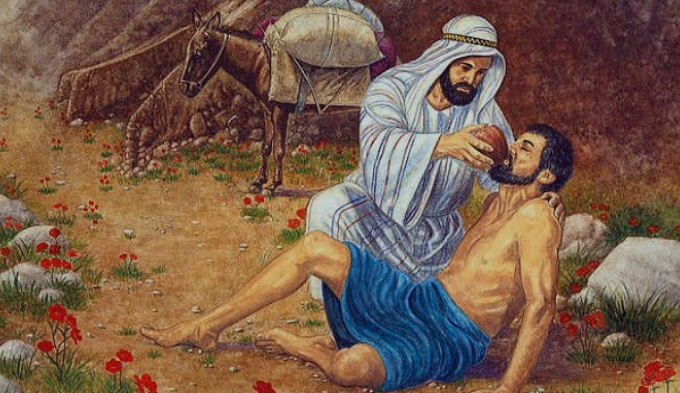
Chapter 1: The Neighbor As Enemy: Confronting Prejudice In The Parable of The Good Samaritan (Luke 10:25-37)
25. And, behold, a certain lawyer stood up, and tempted him, saying, Master, what shall I do to inherit eternal life?
26. He said unto him, What is written in the law? how readest thou?
27. And he answering said, Thou shalt love the Lord thy God with all thy heart, and with all thy soul, and with all thy strength, and with all thy mind; and thy neighbour as thyself.
28. And he said unto him, Thou hast answered right: this do, and thou shalt live.
29. But he, willing to justify himself, said unto Jesus, And who is my neighbour?
30. And Jesus answering said, A certain man went down from Jerusalem to Jericho, and fell among thieves, which stripped him of his raiment, and wounded him, and departed, leaving him half dead.
31. And by chance there came down a certain priest that way: and when he saw him, he passed by on the other side.
32. And likewise a Levite, when he was at the place, came and looked on him, and passed by on the other side.
33. But a certain Samaritan, as he journeyed, came where he was: and when he saw him, he had compassion on him,
34. And went to him, and bound up his wounds, pouring in oil and wine, and set him on his own beast, and brought him to an inn, and took care of him.
35. And on the morrow when he departed, he took out two pence, and gave them to the host, and said unto him, Take care of him; and whatsoever thou spendest more, when I come again, I will repay thee.
36. Which now of these three, thinkest thou, was neighbour unto him that fell among the thieves?
37. And he said, He that shewed mercy on him. Then said Jesus unto him, Go, and do thou likewise.
The Parable of the Good Samaritan is frequently reduced to a simple exhortation to kindness. While it certainly teaches compassion, its primary force is a radical confrontation with ethnic prejudice and religious hypocrisy, delivered through a narrative structure that masterfully subverts the expectations of its audience.
1.1 The Legal and Theological Frame: A Lawyer's Test
The story does not begin in a vacuum; it is a calculated response to a legal and theological challenge. The interlocutor is described as a "lawyer," an expert in Mosaic Law, who stood up to "tempted him,". His opening question, "Master, what shall I do to inherit eternal life?" is not a philosophical inquiry but a legal one, seeking a definition of the precise requirements for salvation under the Torah.
Jesus, in a characteristic move, turns the question back to the expert: "What is written in the law? how readest thou?". The lawyer provides the correct, orthodox summary, combining two central commands from the Hebrew Scriptures: "Thou shalt love the Lord thy God with all thy heart, and with all thy soul, and with all thy strength, and with all thy mind; and thy neighbour as thyself". This answer synthesizes the core tenets of Deuteronomy 6:5 and Leviticus 19:18.
Jesus affirms his answer, but the lawyer, desiring to justify himself, presses further with a clarifying question: "And who is my neighbor?". This is the critical juncture. The lawyer is not asking for information; he is seeking a legal boundary. In the context of the Old Testament and later Jewish tradition, the term "neighbor" was generally understood to refer to a fellow Israelite or, at its most expansive, a resident alien living within Israel's borders. The lawyer's question is an attempt to define the limits of his obligation, to clarify who falls inside the circle of responsibility and, by implication, who falls outside it. It is a quest for a loophole, a way to fulfill the letter of the law without embracing its radical spirit.
1.2 The Failure of the Religious Elite: The Priest and the Levite
Jesus responds not with a legal definition but with a story. The setting is the treacherous, wilderness road from Jerusalem to Jericho, a steep descent of over 3,000 feet known to be frequented by robbers, making the scenario immediately plausible to his audience. A man, presumably a Jew, is attacked, stripped, beaten, and left for dead.
The first two people to happen upon the victim are figures of the highest religious standing: a priest and a Levite. Both were from the tribe of Aaron and served in the Temple in Jerusalem, representing the official leadership of the Jewish people. Their response is identical and deliberate: upon seeing the wounded man, each "passed by on the other side".
The most common explanation for their inaction is the concern for ritual purity. According to laws in Leviticus 21 and Numbers 19, contact with a dead body would render a priest ritually unclean, disqualifying him from performing his sacred Temple duties. Fearing the man might be dead or might die if touched, they prioritize their religious obligations over the immediate, life-threatening need of a human being. This choice starkly illustrates a form of religious hypocrisy where adherence to cultic regulations becomes a justification for abandoning the core command to love one's neighbor. The very individuals who should have exemplified the law's compassionate intent are shown to be its most egregious violators in practice.
1.3 The Shock of the Unlikely Hero: The Samaritan
After the failure of the religious establishment, Jesus introduces the story's hero, an act of profound narrative subversion. "But a certain Samaritan, as he journeyed, came where he was". For the first-century Jewish audience, the term "good Samaritan" would have been a jarring oxymoron. The animosity between Jews and Samaritans was ancient and deeply entrenched. Jews viewed Samaritans as "heretics and half-breeds," descendants of Israelites who had intermarried with foreign colonists after the Assyrian conquest and had established a rival temple on Mount Gerizim. Each group considered itself the true heir of Abraham and viewed the other as apostate. This hostility was not merely theological; it was historical, marked by events such as the destruction of the Samaritan temple by the Jewish Hasmonean king John Hyrcanus in the second century B.C.E. Jews would often travel miles out of their way to avoid passing through Samaria.
The power of the parable hinges on this deep-seated prejudice; it is designed to work only if the audience assumes Samaritans are inherently bad people. Against this backdrop, the Samaritan's actions are revolutionary. When he saw the man, "he had compassion". The Greek word used here, splagchnizomai, denotes a visceral, gut-wrenching empathy that moves one to action. It is the same word used to describe Jesus's own compassion for the suffering crowds. This instinctive empathy contrasts sharply with the calculated avoidance of the priest and Levite.
The Samaritan's compassion is not a fleeting emotion but a catalyst for costly, risky, and comprehensive action. He bandages the man's wounds, using his own oil and wine as antiseptics. He places the man on his own animal, forcing himself to walk. He takes him to an inn and cares for him through the night. The next day, he pays the innkeeper two denarii which is equivalent to two full days' wages for a laborer and makes an open-ended promise to cover any further expenses, saying, "whatsoever thou spendest more, when I come again, I will repay thee". He does all this for a man who is likely his ethnic and religious enemy, in hostile territory where he himself could be in danger.
1.4 The Parable's Reversal: From "Who Is?" to "Who Was?"
At the story's conclusion, Jesus masterfully turns the tables on the lawyer. He does not provide the abstract definition the lawyer sought. Instead, he asks a concrete, action-oriented question: "Which now of these three, thinkest thou, was neighbour unto him that fell among the thieves?". The question is no longer "Who is my neighbor?" (a question of identity) but "Who acted as a neighbor?" (a question of conduct).
The lawyer's response is telling. He cannot bring himself to utter the word "Samaritan." He answers evasively, "He that shewed mercy on him". In this reluctant admission, he is forced to concede that the despised outsider, not the religious insider, is the one who truly fulfilled the law. Jesus's final, terse command, "Go, and do thou likewise" is the parable's ultimate point. It transforms "neighbor" from a static category to be defined into a dynamic verb to be performed. The command is not to define your neighbor, but to be one, even, and especially, to your enemy.
The lawyer began by asking about the boundaries of his covenant obligations, hoping to use the law to define who he could legitimately exclude. In a stroke of narrative genius, Jesus uses the parable to show that true fulfillment of the law is demonstrated not by one's lineage or religious office but by the active practice of mercy. The Samaritan, an outsider to the Judean covenant community, becomes the sole character who actually embodies the law's command to "love thy neighbor." This makes the parable a powerful legal counter-argument, dismantling the lawyer's attempt to use the law for exclusion and instead weaponizing it to obligate him to act with the same grace as his hated enemy.
Furthermore, the narrative forces a radical shift in perspective. The victim in the story is deliberately left anonymous as he is stripped of his clothes, which might have indicated his status, and is left half-dead and unable to speak. A Jewish audience would naturally identify with the victim, assuming him to be a fellow Jew. This brilliant narrative choice forces the listener, including the lawyer, to identify not with the powerful religious figures or even the heroic Samaritan, but with the helpless, bleeding man in the ditch. From this position of extreme vulnerability, the listener is compelled to ask a different question: not "Who am I obligated to help?" but "Who would I want to help me?" The answer from the ditch is, unequivocally, "anyone." By placing the listener in this state of desperate need, Jesus forces them to experience their own dependence on mercy from the very person they despise. The parable's genius is that it makes the prejudiced listener an implicit recipient of the Samaritan's grace, thereby exposing the profound absurdity of their own exclusionary worldview.
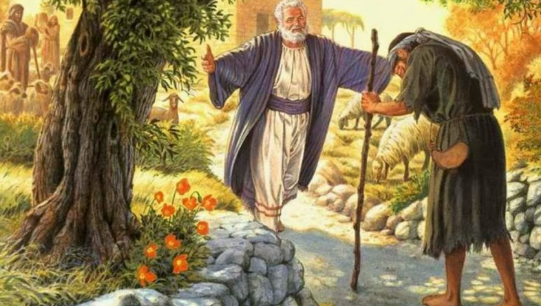
Chapter 2: The Righteous & The Resentful: Exposing Self-Righteousness In The Parable of the Prodigal Son (Luke 15:11-32)
11. And he said, A certain man had two sons:
12. And the younger of them said to his father, Father, give me the portion of goods that falleth to me. And he divided unto them his living.
13. And not many days after the younger son gathered all together, and took his journey into a far country, and there wasted his substance with riotous living.
14. And when he had spent all, there arose a mighty famine in that land; and he began to be in want.
15. And he went and joined himself to a citizen of that country; and he sent him into his fields to feed swine.
16. And he would fain have filled his belly with the husks that the swine did eat: and no man gave unto him.
17. And when he came to himself, he said, How many hired servants of my father’s have bread enough and to spare, and I perish with hunger!
18. I will arise and go to my father, and will say unto him, Father, I have sinned against heaven, and before thee,
19. And am no more worthy to be called thy son: make me as one of thy hired servants.
20. And he arose, and came to his father. But when he was yet a great way off, his father saw him, and had compassion, and ran, and fell on his neck, and kissed him.
21. And the son said unto him, Father, I have sinned against heaven, and in thy sight, and am no more worthy to be called thy son.
22. But the father said to his servants, Bring forth the best robe, and put it on him; and put a ring on his hand, and shoes on his feet:
23. And bring hither the fatted calf, and kill it; and let us eat, and be merry:
24. For this my son was dead, and is alive again; he was lost, and is found. And they began to be merry.
25. Now his elder son was in the field: and as he came and drew nigh to the house, he heard musick and dancing.
26. And he called one of the servants, and asked what these things meant.
27. And he said unto him, Thy brother is come; and thy father hath killed the fatted calf, because he hath received him safe and sound.
28. And he was angry, and would not go in: therefore came his father out, and intreated him.
29. And he answering said to his father, Lo, these many years do I serve thee, neither transgressed I at any time thy commandment: and yet thou never gavest me a kid, that I might make merry with my friends:
30. But as soon as this thy son was come, which hath devoured thy living with harlots, thou hast killed for him the fatted calf.
31. And he said unto him, Son, thou art ever with me, and all that I have is thine.
32. It was meet that we should make merry, and be glad: for this thy brother was dead, and is alive again; and was lost, and is found.
Often called the Parable of the Prodigal Son, this story is more accurately the Parable of the Loving Father and His Two Lost Sons. While the narrative of the younger son's rebellion and return is dramatic, the parable's theological climax and its primary target lie in the confrontation with the self-righteous older brother, who represents the very religious leaders Jesus was addressing.
2.1 The Scandal of the Younger Son's Request
The parable begins with an act of profound cultural offense. The younger son demands of his father, "give me the portion of goods that falleth to me". In the patriarchal society of first-century Judea, inheritance was transferred upon the father's death. A son's inheritance was not an entitlement to be claimed during the father's lifetime. This demand was therefore a shocking repudiation of the father's authority and affection, tantamount to saying, "I value your property more than your life. I wish you were dead". The father's acquiescence, dividing his livelihood between his sons, is the first sign of his extraordinary, boundary-breaking love.
The son's subsequent journey to a "far country" where he "wasted his substance with riotous living" completes his rejection of family and community. His descent culminates in the ultimate degradation for a Jewish man: he is forced by famine to hire himself out to feed pigs, unclean animals according to Jewish law. He becomes so destitute that he longs to eat the pods the pigs were eating, a state of utter shame and dehumanization. When "he come to himself" is not born of noble repentance, but of desperate, pragmatic hunger: "How many hired servants of my father's have bread enough and to spare, and I perish with hunger!".
2.2 The Extravagance of the Father's Grace
The father's response to his son's return is as scandalous as the son's initial request. The text states that "while he was still far off, his father saw him and was filled with compassion; he ran and put his arms around him and kissed him". For an elderly patriarch in that culture, running was an act of undignified haste, exposing his ankles in a way that was considered shameful. This action signifies a love that casts aside personal dignity in its desperate eagerness to welcome the lost.
Significantly, the father interrupts the son's carefully rehearsed speech of contrition. The son begins, "Father, I have sinned against heaven, and before thee, And am no more worthy to be called thy son: make me as one of thy hired servants". He intends to ask to be treated as a hired hand, a transactional relationship based on labor. But the father cuts him off before he can make this request, refusing to allow the relationship to be renegotiated on the son's terms of unworthiness. Instead, he immediately and publicly restores him to full sonship. He commands his servants to bring "the best robe" (a symbol of honor), "a ring on his hand" (a sign of authority and sonship), and "shoes on his feet" (a marker of a free man, as slaves went barefoot). He then orders the killing of the "fatted calf," reserved for the most joyous and significant of celebrations. The father's declaration, "For this my son was dead, and is alive again; he was lost, and is found" frames the event not as the pardoning of a misdeed but as a resurrection.
2.3 The Older Brother: Lost at Home
The parable's setting is crucial: Jesus tells this story, along with the parables of the Lost Sheep and the Lost Coin, in direct response to the Pharisees and scribes who were "grumbling and saying, 'This fellow welcomes sinners and eats with them'". The character of the older brother is a direct and unmistakable proxy for these religious leaders.
Upon returning from the field, the older brother hears the celebration and becomes angry, refusing to go inside. His complaint to his father reveals the true nature of his heart: "Lo, these many years do I serve thee, neither transgressed I at any time thy commandment: and yet thou never gavest me a kid, that I might make merry with my friends:". The Greek word he uses for "serve" is one associated with the work of a slave, exposing a relationship built not on love and intimacy but on joyless, transactional servitude. He sees his obedience as a means to an end, a form of labor that should earn him specific rewards. His worldview is one of law, merit, and payment, not love and graciousness.
His alienation is further revealed by his inability to acknowledge his familial bond. He does not refer to the prodigal as "my brother" but contemptuously distances himself, calling him "this thy son". This verbal severing of the relationship demonstrates a complete lack of mercy and a heart hardened by self-righteousness. He is lost not in a distant country of licentiousness, but in the nearer, more dangerous country of his own pride.
2.4 The Unresolved Ending
The father's response to his older son is not a rebuke but a gentle, pleading invitation: "Son, thou art ever with me, and all that I have is thine". This statement is a profound correction of the son's slave mentality. It reminds him that his status is not that of a servant earning wages but of a son who already possesses the full inheritance and enjoys constant fellowship with the father. The celebration is not a diminishment of the older son's status but a necessary response to a family resurrection: "It was meet that we should make merry, and be glad: for this thy brother was dead, and is alive again; and was lost, and is found".
The parable concludes abruptly, without revealing whether the older brother accepts the invitation to join the party. This unresolved ending is a deliberate rhetorical device. It leaves the question hanging in the air, directed squarely at the Pharisees and scribes listening to the story. Jesus is asking them: Will you, the religiously observant, join the heavenly celebration for the repentant "sinners" you despise? Or will you remain outside, isolated in your anger and self-righteousness, lost even while standing at the door of your Father's house?
The narrative masterfully contrasts two distinct forms of being "lost." The younger son represents a lostness characterized by overt rebellion, moral failure, and external sin. His journey into a "far country" is geographical and behavioral. The older son, however, represents a more insidious form of lostness, one of internal sin, characterized by pride, resentment, and self-righteousness. By dutifully staying home and "obeying," he has constructed a works-based identity that renders him incapable of understanding or participating in grace. His "far country" is the spiritual distance he has created in his own heart while physically remaining in his father's house. Through this character, Jesus diagnoses the spiritual condition of the Pharisees as being just as lost, and perhaps more dangerously so, than that of the tax collectors and sinners they condemned.
The father's final statement to the older son, "all that I have is thine" functions as both a profound comfort and a gentle rebuke. The son's complaint, "thou never gavest me a kid" reveals his transactional worldview, where blessings are seen as discrete payments for services rendered. The father's response completely reframes this perspective. It implies, "You have been living in a state of constant abundance as my son, yet you have chosen to adopt the mindset of a slave, meticulously counting your wages and envying the gifts given to others." This reveals that the older son's misery is not a result of being unrewarded but is entirely self-inflicted. He has had continuous access to the father's generosity but has been blinded to it by his own scorekeeping and resentment. The true tragedy of the older brother is not that he is unappreciated, but that he is incapable of enjoying the inheritance he already possesses.
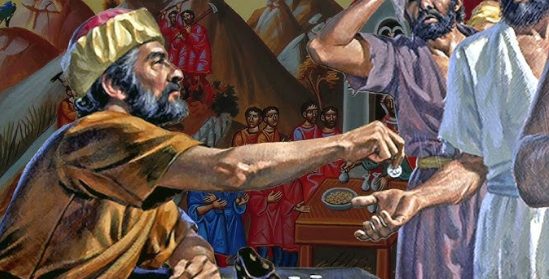
Chapter 3: The Scandal of Extravagant Grace: Deconstructing Merit In The Parable of The Workers In The Vineyard (Matthew 20:1-16)
- For the kingdom of heaven is like unto a man that is an householder, which went out early in the morning to hire labourers into his vineyard.
- And when he had agreed with the labourers for a penny a day, he sent them into his vineyard.
- And he went out about the third hour, and saw others standing idle in the marketplace,
- And said unto them; Go ye also into the vineyard, and whatsoever is right I will give you. And they went their way.
- Again he went out about the sixth and ninth hour, and did likewise.
- And about the eleventh hour he went out, and found others standing idle, and saith unto them, Why stand ye here all the day idle?
- They say unto him, Because no man hath hired us. He saith unto them, Go ye also into the vineyard; and whatsoever is right, that shall ye receive.
- So when even was come, the lord of the vineyard saith unto his steward, Call the labourers, and give them their hire, beginning from the last unto the first.
- And when they came that were hired about the eleventh hour, they received every man a penny.
- But when the first came, they supposed that they should have received more; and they likewise received every man a penny.
- And when they had received it, they murmured against the goodman of the house,
- Saying, These last have wrought but one hour, and thou hast made them equal unto us, which have borne the burden and heat of the day.
- But he answered one of them, and said, Friend, I do thee no wrong: didst not thou agree with me for a penny?
- Take that thine is, and go thy way: I will give unto this last, even as unto thee.
- Is it not lawful for me to do what I will with mine own? Is thine eye evil, because I am good?
- So the last shall be first, and the first last: for many be called, but few chosen.
This parable is one of Jesus's most direct and provocative assaults on the human instinct for fairness and meritocracy. By setting the story in the familiar and precarious world of first-century day labor, Jesus constructs a scenario that exposes the radical and often offensive nature of God's grace, which operates on a logic entirely different from human economics.
3.1 The Economic Reality of Day Labor
To grasp the parable's impact, one must first understand the social and economic context of its characters. First-century Judea was a predominantly agrarian society, and day laborers constituted a large, vulnerable segment of the population. These workers would gather in the village marketplace (the agora) at sunrise, hoping to be hired for a single day's work. They had no job security, no contracts, and no collective bargaining power; their livelihood depended entirely on being chosen by a landowner.
The standard wage for a full day of labor was a single silver penny. This was considered a fair, subsistence wage, enough to purchase food for a family for one day. The first group of workers in the parable explicitly agrees to this conventional and just wage: "he had agreed with the labourers for a penny a day". Furthermore, Jewish law, as stipulated in Leviticus 19:13 and Deuteronomy 24:14-15, required that day laborers be paid at the end of the day, before sunset. This was a crucial social protection, as these workers depended on that day's wage to buy that evening's meal. The landowner in the parable adheres to this custom, instructing his foreman to pay the workers when evening came.
3.2 The Landowner's Unconventional Generosity
The landowner's actions begin conventionally but become progressively more unusual. He hires workers not only at the beginning of the day but also at the third, sixth, and ninth hours (approximately 9 a.m., noon, and 3 p.m.). Most strikingly, he goes out again at the "eleventh hour" (around 5 p.m.), with only one hour of work left in the day, and hires those who have been standing idle all day because "no man hath hired us".
The true scandal, however, occurs at payday. The landowner deliberately instructs his foreman to pay the workers in reverse order of their hiring: "Call the labourers, and give them their hire, beginning from the last unto the first". This is a calculated, public demonstration. It ensures that the all-day workers are forced to witness the eleventh-hour worker, who worked for only one hour and each receiving a full penny. This act is not a miscalculation; it is a purposeful display of astonishing generosity. The landowner gives the last workers not what they earned by the hour, but what they needed for the day. His payment is based on grace, not on a prorated calculation of their labor.
3.3 The Grumbling of the First-Hired
As the payment proceeds, the first-hired workers, having witnessed this display, naturally expect to receive more. When they too receive only the one penny they had agreed to, they "murmured against the goodman of the house". Their complaint is the heart of the parable: "These last have wrought but one hour, and thou hast made them equal unto us, which have borne the burden and heat of the day".
It is crucial to note that their complaint is not about injustice in the strict sense; they were not cheated or underpaid. They received exactly the wage they had contracted for. Their anger stems from the perceived unfairness of the landowner's generosity toward others. Their sense of worth was tied not to receiving a fair wage, but to receiving more than those who worked less. The landowner's grace, by making the last equal to the first, has offended their sense of merit and seniority.
3.4 The Theological Punchline: Grace vs. Merit
The landowner's defense cuts to the core of the parable's theological argument. He addresses one of the grumblers with two points. First, he establishes his justice: "Friend, I do thee no wrong: didst not thou agree with me for a penny? Take that thine is, and go thy way". He has fulfilled his legal and moral obligation. Second, he asserts his sovereign right to be generous: "I will give unto this last, even as unto thee. Is it not lawful for me to do what I will with mine own? Is thine eye evil, because I am good?".
This masterfully reframes the entire conflict. The issue is not the landowner's fairness but his generosity, and the workers' problem is not injustice but envy. The parable forces the listener to confront a world where God's grace is not bound by human calculations of effort, time, or merit. The concluding aphorism, "So the last shall be first, and the first last" serves as the final reversal, directly challenging anyone who believes that their long service or strenuous effort in the "vineyard" entitles them to a special status or a greater reward from God.
This story serves as a potent critique of a "meritocracy of salvation." The first-hired workers are not portrayed as victims of injustice but as individuals consumed by envy. They were perfectly content with their fair contract until they witnessed others receiving unmerited grace. Their protest, "thou hast made them equal unto us" reveals that their satisfaction was not rooted in their own provision but in their perceived superiority over others. The parable thus exposes a dark undercurrent of the human condition: the offense taken at grace shown to others can be more powerful than the gratitude for justice shown to oneself. Jesus is diagnosing the same spiritual malady seen in the older brother of the Prodigal Son, the tendency to measure one's standing with God through comparison and to resent God's generosity to those deemed less deserving.
The landowner's decision to pay the workers in reverse order is a deliberate piece of theater designed to force this very confrontation. He could have paid each worker privately to avoid conflict. Instead, he stages the payment sequence as a public, pedagogical act. This public display is not for administrative efficiency but for theological instruction. It forces the all-day workers to watch the economy of grace unfold before their eyes, causing their expectation to build ("they expected to receive more") and making their subsequent grumbling an inevitability. Jesus structures the narrative this way to provoke the exact human reaction he wishes to address. The parable is not merely about grace; it is designed to make the listener feel the deep offense of grace when it is viewed through the limited lens of human fairness, thereby exposing the listener's own internal resistance to the sovereign and scandalous generosity of God.
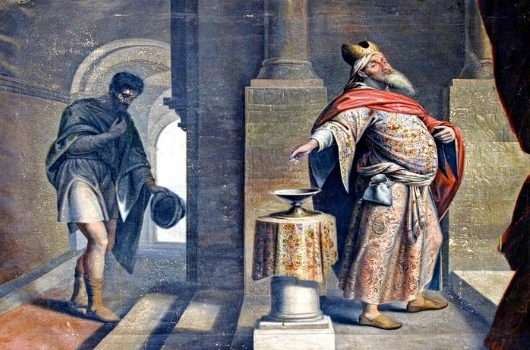
Chapter 4: The Great Reversal: Redefining Justification In The Parable of The Pharisee & Tax Collector (Luke 18:9-14)
9. And he spake this parable unto certain which trusted in themselves that they were righteous, and despised others:
10. Two men went up into the temple to pray; the one a Pharisee, and the other a publican.
11. The Pharisee stood and prayed thus with himself, God, I thank thee, that I am not as other men are, extortioners, unjust, adulterers, or even as this publican.
12. I fast twice in the week, I give tithes of all that I possess.
13. And the publican, standing afar off, would not lift up so much as his eyes unto heaven, but smote upon his breast, saying, God be merciful to me a sinner.
14. I tell you, this man went down to his house justified rather than the other: for every one that exalteth himself shall be abased; and he that humbleth himself shall be exalted.
This short, powerful parable delivers one of the most concentrated expressions of Jesus's theology of grace and humility. By contrasting two archetypal figures from first-century Jewish society, Jesus completely upends conventional religious expectations and redefines the very basis on which a person is made right with God.
4.1 The Social and Religious Context
The parable's purpose is stated explicitly from the outset: Jesus told it "unto certain which trusted in themselves that they were righteous, and despised others". The two characters chosen to embody this conflict could not be more polarized in the social landscape of the time.
Pharisees were a prominent and widely respected religious sect. They were known for their zealous devotion to the Mosaic Law and the oral traditions surrounding it. In the popular imagination, they were the epitome of piety and moral uprightness, seen as spiritual exemplars for the nation. The Pharisee in the parable is depicted as exceeding the standard religious requirements: he fasts "twice in the week" (the Law required only one annual fast on the Day of Atonement) and gives "tithes of all that I possess" going beyond the tithes required by the Law.
Tax collectors (or publicans) occupied the opposite end of the social spectrum. As local Jews contracted by the Roman authorities to collect taxes, they were universally despised as traitors and collaborators with the oppressive occupying force. Their profession was synonymous with corruption, as they were known to extort more than was required to enrich themselves. They were considered ritually unclean due to their constant contact with Gentiles and were often lumped together with "extortioners", "unjust" and "adulterers" as the lowest stratum of society.
4.2 Two Prayers, Two Postures
The two men go to the temple to pray, but their approaches to God are diametrically opposed, revealed in both their physical posture and the content of their prayers.
The Pharisee's Prayer: He "stood and prayed thus with himself" a posture that may suggest confidence but also physical and spiritual separation from the common person. His prayer is not a petition for mercy or an expression of praise to God, but a litany of self-congratulation. He begins with a pro forma "God, I thank thee" but the object of his gratitude is his own superiority: "that I am not as other men are, extortioners, unjust, adulterers, or even as this publican". He presents God with a spiritual resume, listing his righteous deeds as the basis for his standing. His prayer is fundamentally a dialogue with himself, using God as a mirror to reflect his own perceived piety.
The Tax Collector's Prayer: In stark contrast, the tax collector stands "afar off" a physical manifestation of his profound sense of unworthiness. He is so overcome with shame that he "would not lift up so much as his eyes unto heaven". He beats his breast, a traditional gesture of deep sorrow and repentance. His prayer is short, desperate, and devoid of any self-justification: "God be merciful to me a sinner". He makes no comparisons and offers no credentials, only a raw admission of his need.
4.3 The Shocking Verdict: Justification Redefined
Jesus concludes the parable with a verdict that would have stunned his original audience. "I tell you, this man went down to his house justified rather than the other: for every one that exalteth himself shall be abased; and he that humbleth himself shall be exalted". The term "justified", declared righteous in God's sight which is completely detached from the Pharisee's impressive record of religious observance and is instead bestowed upon the despised social outcast.
This shocking outcome is then distilled into one of the central themes of Luke's Gospel, often called the "Great Reversal": Luke 14:11: "For whosoever exalteth himself shall be abased; and he that humbleth himself shall be exalted". The parable serves as the ultimate illustration of this principle. Justification is not a reward for moral achievement but a gift given in response to humble repentance.
This story radically redefines righteousness not as a moral status one achieves through performance, but as a relational posture one assumes before God. The Pharisee operates under the belief that righteousness is an accomplishment, and his prayer is effectively a spiritual balance sheet presented to God for approval. He trusts in his own works. The tax collector, conversely, has no works to present. His only asset is the character of the God to whom he prays. His plea for mercy is an act of pure, desperate dependence. Jesus's verdict reveals that God's justification is not an audit of our moral accounts but a relational response to our posture. God declares righteous the one who approaches in humble need, not the one who approaches with a list of self-acclaimed virtues. Righteousness, therefore, is not a possession to be defended but a gift to be received in a moment of complete self-emptying.
Furthermore, the Pharisee's primary sin is not simply pride in his own actions, but the contempt for another that this pride generates. The parable is explicitly directed at those who despised others. The Pharisee's prayer is an act of comparison and condemnation: "I thank thee, that I am not as other men are, extortioners, unjust, adulterers, or even as this publican". In this act, he arrogates to himself God's role as judge. He transforms prayer, an act of communion with God, into a platform for creating spiritual and social distance from his fellow man. The tax collector, in his simple plea, mentions no one but himself and God. The parable powerfully suggests that any claim to righteousness that results in contempt for another human being is, by its very nature, illegitimate in God's eyes. The Pharisee's vertical relationship with God is rendered null and void by the brokenness of his horizontal relationship with his neighbor.
Part II: Parables of The Kingdom's Disruptive Nature

Chapter 5: The Uncontrollable Mustard Seed: The Subversive Growth of The Kingdom In The Parable of The Mustard Seed (Matthew 13:31-32)
31. Another parable put he forth unto them, saying, The kingdom of heaven is like to a grain of mustard seed, which a man took, and sowed in his field:
32. Which indeed is the least of all seeds: but when it is grown, it is the greatest among herbs, and becometh a tree, so that the birds of the air come and lodge in the branches thereof.
Commonly interpreted as a simple illustration of growth from small beginnings, the Parable of the Mustard Seed contains a subversive and scandalous element that would have been immediately apparent to its first-century agrarian audience. Jesus's choice of plant is a deliberate and provocative act of theological redefinition.
5.1 The Conventional Symbol of a Kingdom
In the symbolic language of the Hebrew Scriptures, the expected image for a great and protective world empire was a mighty, majestic tree. Specifically, the cedar of Lebanon was a potent symbol of strength, grandeur, and divine favor. The prophet Ezekiel in Ezekiel 17:23, for instance, uses the image of a towering cedar under which "all fowl of every wing" will nest to describe the restored kingdom of Israel. This image conveyed stability, permanence, and national glory. When Jesus spoke of a kingdom, his audience would have had such powerful, traditional symbols in mind.
5.2 Jesus's Unconventional Choice: The Mustard Plant
Jesus deliberately sidesteps this majestic imagery. He compares the kingdom of heaven not to a cedar but to a mustard seed, which he describes as "a grain of mustard seed". This immediately establishes a theme of humble, almost invisibly small beginnings, a stark contrast to the expected grandeur of a messianic kingdom.
The plant in question is generally identified as black mustard (Brassica nigra), a species common in the region. This plant can indeed grow with surprising rapidity into a large, bushy shrub reaching heights of nine feet or more, becoming the largest of garden plants. However, it is still a shrub, not a true tree like a cedar. Jesus's description of it "becometh a tree" is a form of hyperbolic extravagance, emphasizing its remarkable growth but also highlighting its humble nature.
5.3 The "Subversive and Scandalous" Element
The true shock of the parable lies in the botanical reputation of the mustard plant. To many first-century farmers and gardeners, mustard was not a desirable plant but a "malignant weed" with "dangerous takeover properties". Its rapid, aggressive growth could quickly overwhelm a cultivated garden or field. The Roman naturalist Pliny the Elder, writing in the first century, noted that "when it has once been sown it is scarcely possible to get the place free of it, as the seed when it falls germinates at once". Due to this invasive nature, rabbinical sources indicate that planting mustard in a garden was often discouraged or prohibited.
For Jesus to compare the kingdom of God to this particular plant would have been startling. It would be the modern equivalent of a preacher declaring, "The kingdom of heaven is like kudzu," or "The kingdom of heaven is like a dandelion that spreads an unstoppable plague across well-manicured lawns". He deliberately chose an image associated with uncontrollable, invasive, and disruptive growth.
5.4 The Meaning of the Kingdom's Growth
The parable's most accessible meaning is indeed the powerful growth of the kingdom from tiny, insignificant beginnings to a worldwide presence. The man who sows the seed is Jesus, and the resultant plant is the Kingdom of God, which will grow to provide shelter for "the birds of the air", a phrase that can symbolize the inclusion of Gentiles or marginalized "sinners" into the community of faith.
However, the nature of the mustard plant adds a crucial, subversive layer to this meaning. The growth of God's kingdom is not portrayed as orderly, predictable, or easily managed like a cultivated cedar in a royal park. Instead, it is presented as an inexorable, wild, and irrepressible force. It spreads in unexpected ways, takes root in places where it is not wanted, and proves impossible to contain or eradicate. The parable suggests that the kingdom is something that some people will find to be a welcome shelter, while other, those invested in maintaining the order of their own well-tended "gardens" will find it "obnoxious" and a threat to be rooted out.
The choice of a mustard plant instead of a cedar is a direct challenge to the prevailing nationalistic and political expectations of the Messiah's kingdom. The image of a grand cedar was deeply connected to hopes for the restoration of Israel's political sovereignty and national glory. By selecting a common, invasive, and ritually ambiguous weed Jesus deliberately subverts these messianic hopes. He signals that the Kingdom of God will not be a restored political empire, akin to a majestic cedar of Lebanon, but something far more grassroots, uncontrollable, and disruptive. It will not be planted neatly within the established "garden" of official Judaism but will spread like a weed through the field of the entire world. This invasive plant will offer shelter to unexpected "birds," a metaphor for Gentiles or the ritually impure, who find refuge in its branches.
This suggests that the very nature of the Kingdom is to be an invasive presence that redefines the existing landscape. A weed does not respect the carefully drawn boundaries of a garden; it grows where it will, often displacing the cultivated plants. This implies that the Kingdom of God is not meant to simply integrate into existing human structures, be they religious, social, or political. Its presence is inherently transformative and disruptive; it takes over. This interpretation clarifies why the kingdom's arrival would be perceived by some as a welcome shelter and by others as an "obnoxious" threat to the established order, a thing to be resisted and eradicated. The parable is not just about growth, but about a specific kind of growth: subversive, boundary-breaking, and ultimately world-altering.
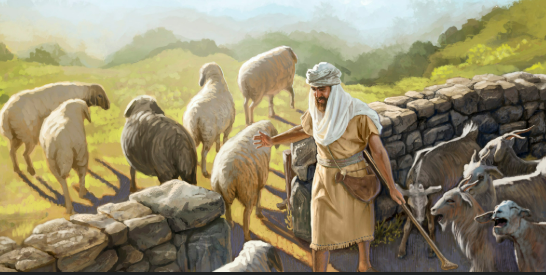
Chapter 6: The King's Emissaries: Re-identifying "The Least of These" In The Parable of The Sheep & Goats (Matthew 25:31-46)
31. When the Son of man shall come in his glory, and all the holy angels with him, then shall he sit upon the throne of his glory:
32. And before him shall be gathered all nations: and he shall separate them one from another, as a shepherd divideth his sheep from the goats:
33. And he shall set the sheep on his right hand, but the goats on the left.
34. Then shall the King say unto them on his right hand, Come, ye blessed of my Father, inherit the kingdom prepared for you from the foundation of the world:
35. For I was an hungred, and ye gave me meat: I was thirsty, and ye gave me drink: I was a stranger, and ye took me in:
36. Naked, and ye clothed me: I was sick, and ye visited me: I was in prison, and ye came unto me.
37. Then shall the righteous answer him, saying, Lord, when saw we thee an hungred, and fed thee? or thirsty, and gave thee drink?
38. When saw we thee a stranger, and took thee in? or naked, and clothed thee?
39. Or when saw we thee sick, or in prison, and came unto thee?
40. And the King shall answer and say unto them, Verily I say unto you, Inasmuch as ye have done it unto one of the least of these my brethren, ye have done it unto me.
41. Then shall he say also unto them on the left hand, Depart from me, ye cursed, into everlasting fire, prepared for the devil and his angels:
42. For I was an hungred, and ye gave me no meat: I was thirsty, and ye gave me no drink:
43. I was a stranger, and ye took me not in: naked, and ye clothed me not: sick, and in prison, and ye visited me not.
44. Then shall they also answer him, saying, Lord, when saw we thee an hungred, or athirst, or a stranger, or naked, or sick, or in prison, and did not minister unto thee?
45. Then shall he answer them, saying, Verily I say unto you, Inasmuch as ye did it not to one of the least of these, ye did it not to me.
46. And these shall go away into everlasting punishment: but the righteous into life eternal.
Positioned at the climax of the Olivet Discourse, the Parable of the Sheep and Goats is one of Jesus's most powerful and sobering depictions of the final judgment. While its message is often generalized into a universal call for social action, a closer examination of its language within the context of Matthew's Gospel suggests a more specific and radical interpretation concerning the identity of Christ and the nature of mission.
6.1 The Scene of Final Judgment
The setting is unambiguously eschatological. The narrative describes the return of the Son of Man "shall come in his glory, and all the holy angels with him" at which point he will sit on his "throne of his glory". Before him, "shall be gathered all nations" and he will enact a final, absolute separation, "he shall separate them one from another, as a shepherd divideth his sheep from the goats". The imagery is stark and the stakes are ultimate: the "sheep" on his right are blessed and "ye blessed of my Father, inherit the kingdom prepared for you from the foundation of the world" while the "goats" on his left are cursed and depart into eternal punishment.
6.2 The Surprising Criterion for Judgment
The sole basis for this eternal separation is startling in its simplicity and concreteness. The King's judgment rests entirely on acts of tangible compassion: "For I was an hungred, and ye gave me meat: I was thirsty, and ye gave me drink: I was a stranger, and ye took me in: Naked, and ye clothed me: I was sick, and ye visited me: I was in prison, and ye came unto me". The goats are condemned for their failure to perform these same acts.
Conspicuously absent from the criteria is any mention of theological belief, doctrinal purity, religious ritual, or church affiliation. The judgment is based not on what people professed, but on what they did or failed to do for "one of the least of these my brethren, ye have done it unto me".
A crucial element of the narrative is the profound surprise of both groups. The righteous sheep are genuinely perplexed: "Lord, when saw we thee an hungred, and fed thee? or thirsty, and gave thee drink? When saw we thee a stranger, and took thee in? or naked, and clothed thee? Or when saw we thee sick, or in prison, and came unto thee?". Neither group was aware that their actions (or inactions) toward the suffering were, in fact, their direct response to the King himself.
6.3 The Identity of "The Least of These"
The interpretation of the parable hinges on the identity of the third group mentioned: "the least of these".
The traditional and most common interpretation understands this phrase to refer to all poor, marginalized, and suffering people throughout the world. In this view, the parable is a universal mandate for social justice and charitable works, teaching that serving any person in need is equivalent to serving Christ.
However, a compelling alternative interpretation, grounded in the specific language and themes of Matthew's Gospel, argues that "the least of these" refers specifically to Jesus's own disciples, particularly those sent out as vulnerable, itinerant missionaries. Several textual clues support this reading:
-
"My Brethren": Throughout Matthew's Gospel, Jesus reserves the term "brethren" (adelphoi) for his disciples. For instance, in Matthew 12:49, he gestures toward his disciples and declares, "Behold my mother and my brethren!".
-
The Cost of Discipleship: Jesus explicitly warns that following him involves embracing the very conditions of vulnerability listed in the parable. He tells a prospective follower, "The foxes have holes, and the birds of the air have nests; but the Son of man hath not where to lay his head." in Matthew 8:20. To be a disciple is to risk becoming a homeless stranger, dependent on the charity of others.
-
The Missionary Discourse: In Matthew 10, when Jesus sends the twelve disciples on their mission, he instructs them to travel without money or extra provisions, making them completely dependent on the hospitality of those they encounter. He then explicitly identifies himself with these vulnerable emissaries, stating, "He that receiveth you receiveth me" in Matthew 10:40 and promising that anyone who gives "whosoever shall give to drink unto one of these little ones a cup of cold water only in the name of a disciple, verily I say unto you, he shall in no wise lose his reward" in Matthew 10:42. This provides a direct parallel to the language and logic of the judgment scene in Matthew .
6.4 Implications of the Alternative Interpretation
If "the least of these" are indeed Jesus's missionary disciples, the parable's focus shifts significantly. It is no longer primarily a lesson for believers on how to treat the world's poor, but a depiction of how the "nations", the non-believing world will be judged based on their reception of the gospel's messengers. The judgment of the nations hinges on how they treated Christ's representatives when they appeared as hungry, thirsty, and imprisoned strangers.
This interpretation does not negate the broader biblical mandate to care for all who are in need. Rather, it gives the parable a specific, missiological focus. It suggests that people can encounter and serve Christ unknowingly by extending hospitality and aid to his followers. The judgment reveals that the world's response to the vulnerable church is its de facto response to Christ himself.
Regardless of which interpretation of "the least of these" is adopted, the central theological assertion remains breathtakingly radical: the glorious, enthroned King, the judge of all nations, identifies himself completely and unequivocally with the hungry, the thirsty, the naked, the stranger, the sick, and the prisoner. This is the ultimate expression of incarnational theology. Christ is not to be found among the powerful, the comfortable, or the exalted, but in the distressing disguise of the needy and vulnerable. The final judgment, therefore, is not a test of abstract belief but a revelation of whether we were able to recognize the face of the King in the face of human suffering.
The genuine surprise of both the sheep and the goats is theologically crucial. The sheep are not commended for implementing a conscious strategy to earn salvation points. Their question, "Lord, when saw we thee an hungred, and fed thee? or thirsty, and gave thee drink? When saw we thee a stranger, and took thee in? or naked, and clothed thee? Or when saw we thee sick, or in prison, and came unto thee?" reveals that their acts of compassion were not transactional; they were the un-self-conscious reflex of a transformed character. They served the needy simply because they were needy. Similarly, the goats were not condemned for a deliberate, conscious rejection of Jesus; they were condemned for their simple obliviousness, their failure to see and respond to the suffering in their midst. This suggests that the final judgment is less a performance review and more a revelation of one's true nature. The actions or inactions are not the cause of one's status as a sheep or a goat, but the definitive evidence of it. Salvation is by grace, and that grace, when truly received, transforms a person into a "sheep" whose fundamental instinct is to love and serve the vulnerable, in whom Christ himself is hidden.
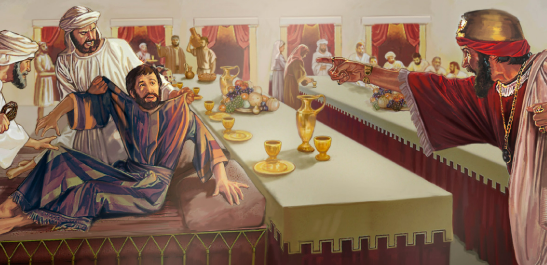
Chapter 7: The Open Door & The Proper Attire: Inclusion & Transformation In The Parable of The Wedding Banquet (Matthew 22:1-14)
- And Jesus answered and spake unto them again by parables, and said,
- The kingdom of heaven is like unto a certain king, which made a marriage for his son,
- And sent forth his servants to call them that were bidden to the wedding: and they would not come.
- Again, he sent forth other servants, saying, Tell them which are bidden, Behold, I have prepared my dinner: my oxen and my fatlings are killed, and all things are ready: come unto the marriage.
- But they made light of it, and went their ways, one to his farm, another to his merchandise:
- And the remnant took his servants, and entreated them spitefully, and slew them.
- But when the king heard thereof, he was wroth: and he sent forth his armies, and destroyed those murderers, and burned up their city.
- Then saith he to his servants, The wedding is ready, but they which were bidden were not worthy.
- Go ye therefore into the highways, and as many as ye shall find, bid to the marriage.
- So those servants went out into the highways, and gathered together all as many as they found, both bad and good: and the wedding was furnished with guests.
- And when the king came in to see the guests, he saw there a man which had not on a wedding garment:
- And he saith unto him, Friend, how camest thou in hither not having a wedding garment? And he was speechless.
- Then said the king to the servants, Bind him hand and foot, and take him away, and cast him into outer darkness; there shall be weeping and gnashing of teeth.
- For many are called, but few are chosen.
This parable, the third in a series of confrontational stories aimed at the religious leaders in Jerusalem, presents a complex and sometimes jarring picture of God's kingdom. It combines the themes of a radically inclusive invitation with a stark warning about the non-negotiable requirement of personal transformation.
7.1 The Custom of the Double Invitation
The parable's opening sequence reflects a common social custom in the ancient Near East: the double invitation. A host would issue an initial invitation well in advance of an event. Then, when the preparations were complete, servants would be sent out a second time to summon the guests who had already accepted, announcing, "call them that were bidden to the wedding".
In the parable, the king sends his servants to call those who had been previously invited to his son's wedding feast. Their refusal to come, making light of the summons and returning to their farms and businesses is therefore not a simple declining of an invitation but a grave and deliberate insult to the king, a violation of a prior commitment. The escalation of this offense, where some of the invited guests seize, mistreat, and kill the king's servants, represents an act of open rebellion.
7.2 The Radical Inclusivity of the Second Invitation
The king's response is twofold and severe. First, he enacts a violent retribution, sending his army to destroy the murderers and burn their city.6 Allegorically, this is often interpreted as a reference to the destruction of Jerusalem in 70 A.D. as a judgment for Israel's rejection of the prophets and the Messiah.
Second, declaring the original guests unworthy, the king initiates a new, shockingly inclusive phase of invitation. He commands his servants, "Go ye therefore into the highways, and as many as ye shall find, bid to the marriage". This command obliterates all previous social and religious boundaries. The servants gather everyone they can, and the wedding hall is filled with a motley crew described as "both good and bad". This symbolizes the expansion of the gospel invitation beyond the initial recipients (the people of Israel) to embrace the Gentiles and all of society's outcasts, the poor, the marginalized, and the ritually impure. The door to the kingdom is thrown open to anyone and everyone, without regard to their past or their social standing.
7.3 The Requirement of the Wedding Garment
The parable takes a sharp turn in its final scene. As the king surveys the guests, he spots a man who is not wearing a wedding garment. In the context of a royal feast in antiquity, it was a common custom for a wealthy host to provide festive garments for his guests to wear, ensuring that all, regardless of their own means, could be appropriately and honorably attired for the celebration.
Therefore, the man without the garment is not an unfortunate poor person who could not afford proper clothes. He is someone who has been offered the king's provision and has refused it. His presence in his own attire is an act of profound disrespect, an implicit declaration that the king's provision is unnecessary and that he will enter the feast on his own terms. The king's question, "Friend, how camest thou in hither not having a wedding garment?" is met with silence. The man "was speechless," indicating he has no valid excuse for his state. His subsequent expulsion into the "outer darkness; there shall be weeping and gnashing of teeth" is the direct consequence of this silent rebellion.
7.4 The Theological Meaning: Grace and Transformation
The parable masterfully holds in tension two fundamental truths about salvation. The first half illustrates the radical, indiscriminate nature of God's grace: the invitation is open to all. The second half, however, issues a stern warning: accepting the invitation is not enough. Entry into the kingdom requires a corresponding inner transformation, which is symbolized by putting on the wedding garment provided by the king.
Theologically, the wedding garment represents the righteousness of Christ, which is freely given by God and must be received by the believer. It signifies a new identity, a life transformed by grace. To refuse the garment is to attempt to enter God's presence based on one's own righteousness, one's own street clothes which are likened in Scripture to "filthy rags" in Isaiah 64:6. The parable concludes with the somber maxim, "For many are called, but few are chosen" emphasizing that a positive response to the universal call of the gospel must be accompanied by the personal appropriation of God's provision for holiness.
The narrative structure of the parable serves as a powerful polemic against the concept of "cheap grace." The first part of the story emphasizes God's shockingly inclusive mercy, as servants are sent to gather people "both good and bad" from the highways. This could easily lead one to assume that entry into the kingdom is unconditional and requires no change from the individual. The second half of the parable, with the dramatic ejection of the improperly dressed guest, acts as a stark and necessary corrective to this potential misunderstanding. It demonstrates that while the invitation to the kingdom is unconditional, full participation in its blessings is not. One cannot simply show up to the feast and expect to remain on one's own terms. Accepting the benefits of the kingdom (the celebration) necessitates submitting to its character (the provided garment). This symbolizes that authentic faith involves not only accepting God's gracious "yes" to us, but also our saying "yes" to His transformative work within us.
The extreme violence depicted in the parable, the murder of servants, the burning of a city, the violent expulsion of a guest has understandably troubled many readers and led to alternative interpretations that question the identification of the king with God. One such reading views the parable not as an allegory for divine judgment, but as a political critique of earthly tyrants, such as King Herod. In this interpretation, the king's actions mirror the coercive and brutal tactics of a worldly ruler whose invitations are commands and whose banquets are displays of power. The man without the wedding garment is then seen not as a presumptuous sinner, but as a non-violent protestor who refuses to conform to the tyrant's demands and is unjustly punished for his integrity. In this subversive reading, the "Kingdom of Heaven" is not found inside the violent king's banquet hall, but "outside" in the darkness with the cast-out victim. This aligns God not with the oppressive ruler but with the suffering and the rejected, a theme consistent with Jesus's frequent reversals of power dynamics.
Part III: Parables of Authentic Discipleship

Chapter 8: The Fearful Servant: Misunderstanding God's Character In The Parable of The Talents (Matthew 25:14-30)
14. For the kingdom of heaven is as a man travelling into a far country, who called his own servants, and delivered unto them his goods.
15. And unto one he gave five talents, to another two, and to another one; to every man according to his several ability; and straightway took his journey.
16. Then he that had received the five talents went and traded with the same, and made them other five talents.
17. And likewise he that had received two, he also gained other two.
18. But he that had received one went and digged in the earth, and hid his lord’s money.
19. After a long time the lord of those servants cometh, and reckoneth with them.
20. And so he that had received five talents came and brought other five talents, saying, Lord, thou deliveredst unto me five talents: behold, I have gained beside them five talents more.
21. His lord said unto him, Well done, thou good and faithful servant: thou hast been faithful over a few things, I will make thee ruler over many things: enter thou into the joy of thy lord.
22. He also that had received two talents came and said, Lord, thou deliveredst unto me two talents: behold, I have gained two other talents beside them.
23. His lord said unto him, Well done, good and faithful servant; thou hast been faithful over a few things, I will make thee ruler over many things: enter thou into the joy of thy lord.
24. Then he which had received the one talent came and said, Lord, I knew thee that thou art an hard man, reaping where thou hast not sown, and gathering where thou hast not strawed:
25. And I was afraid, and went and hid thy talent in the earth: lo, there thou hast that is thine.
26. His lord answered and said unto him, Thou wicked and slothful servant, thou knewest that I reap where I sowed not, and gather where I have not strawed:
27. Thou oughtest therefore to have put my money to the exchangers, and then at my coming I should have received mine own with usury.
28. Take therefore the talent from him, and give it unto him which hath ten talents.
29. For unto every one that hath shall be given, and he shall have abundance: but from him that hath not shall be taken away even that which he hath.
30. And cast ye the unprofitable servant into outer darkness: there shall be weeping and gnashing of teeth.
This parable, often interpreted as a straightforward lesson on using one's God-given abilities, is more fundamentally a profound exploration of how one's perception of God's character directly shapes one's actions. The true failure of the third servant is not financial but theological; his paralysis stems from a fear-based misunderstanding of his master.
8.1 The Master's Trust and the Servants' Actions
The story begins with a master who, before embarking on a long journey, entrusts his property to three of his servants. The sums involved are immense. A "talent" was not a coin but a unit of weight, and a talent of silver was an enormous amount of money, equivalent to approximately 20 years of a common laborer's wages. The master distributes five talents, two talents, and one talent, respectively, making a crucial qualification: he gives "to every man according to his several ability". This act demonstrates both immense trust and astute discernment.
The first two servants immediately put the money to work, engaging in trade and commerce. Both succeed in doubling the master's investment, demonstrating diligence, faithfulness, and a willingness to take calculated risks. The third servant, however, chooses a different path. Motivated by fear, he "went and digged in the earth, and hid his lord's money". His action is one of pure preservation, aimed at avoiding risk and ensuring he can return exactly what he was given.
8.2 The Servant's Mischaracterization of the Master
Upon the master's return "after a long time," the accounting begins. The first two servants present their profits and receive identical praise: "Well done, thou good and faithful servant: thou hast been faithful over a few things, I will make thee ruler over many things: enter thou into the joy of thy lord".
The third servant then comes forward, and his justification for his inaction reveals the core issue of the parable. He does not claim incompetence or lack of opportunity. Instead, he blames his perception of the master's character: "Lord, I knew thee that thou art an hard man, reaping where thou hast not sown, and gathering where thou hast not strawed:And I was afraid, and went and hid thy talent in the earth: lo, there thou hast that is thine". This distorted view of the master as an exacting, exploitative, and punitive taskmaster which is the stated source of his paralyzing fear. He saw God not as a generous giver to be partnered with, but as an angry being to be appeased through risk-averse inaction.
8.3 The Master's Judgment: Condemnation for Inaction
The master's response is scathing. He condemns the servant not for losing the money for he returned it in full, but for his "wicked and slothful" inaction. The punishment is for the disuse, not the abuse, of the entrusted gift. The master cleverly turns the servant's own distorted logic against him: "thou knewest that I reap where I sowed not, and gather where I have not strawed: Thou oughtest therefore to have put my money to the exchangers, and then at my coming I should have received mine own with usury". He exposes the servant's excuse as illogical even on its own terms. If the servant truly believed the master was harsh and demanding, the most minimal, prudent action by depositing the money in a bank that would have been the logical course. His failure to do even this reveals his excuse as a cover for simple sloth.
The consequence is severe. The talent is taken from him and given to the one with ten, followed by the principle, "For unto every one that hath shall be given, and he shall have abundance: but from him that hath not shall be taken away even that which he hath". The unprofitable servant is then thrown "into outer darkness: there shall be weeping and gnashing of teeth".
8.4 Alternative Interpretation: The Master as Oppressor
A significant alternative line of interpretation, often associated with liberation theology and social-scientific criticism, reads the parable not as a story about divine expectation but as a critique of economic exploitation. In this view, the master is not God but an oppressive, absentee landlord, and the servant's description of him as one who reaps where he did not sow is taken as a literal and accurate accusation.
From this perspective, the first two servants are collaborators who participate in their master's unjust, extractive economic practices. The third servant becomes the hero of the story, a prophetic figure who, by burying the talent, courageously refuses to be complicit in an exploitative system. His punishment and expulsion into "outer darkness" are seen as the price of his moral integrity, a martyrdom for resisting the "god of this age". This reading transforms the parable from a call to faithful stewardship into a warning against participating in oppressive economic structures.
While this alternative reading offers a powerful social critique, the primary interpretation holds that the parable's main thrust is theological. It teaches that our understanding of God's character is the single most determinative factor in our spiritual lives. The core difference between the productive servants and the fearful one is not their innate ability or the resources they were given, but their fundamental theology, their perception of the master. The first two servants operate with an implicit trust that the master is generous, that he will reward their faithful risk-taking, and that he desires a productive partnership. Their actions are born of faith. The third servant's explicitly stated theology "I knew thee that thou art an hard man" that leads directly and inevitably to his chosen ethic: risk-averse, fearful paralysis. The parable thus functions as a profound diagnostic tool. It suggests that a spiritual life characterized by fear, inaction, and a constant "playing it safe" is a symptom of a deeply distorted image of God. A true and accurate understanding of God as gracious, generous, and empowering should, by contrast, liberate believers for bold, creative, and fruitful service in His kingdom.
The master's initial distribution, "according to his several ability" is a crucial detail that reframes the entire narrative. The master does not treat his servants as interchangeable units; he recognizes their individual capacities and entrusts them with resources proportionally. This makes the identical praise he gives to both the five-talent and the two-talent servants "Well done, thou good and faithful servant" is theologically significant. The reward is not based on the gross amount returned but on the proportional faithfulness demonstrated in doubling what was given. This implies that God's expectation is not for equal outcomes but for equal faithfulness. The standard is not that everyone produces the same results, but that everyone is fully faithful with the specific gifts, opportunities, and capacities they have been uniquely given. The sin of the third servant is not that he failed to produce five talents, but that he was completely unfaithful with the one talent he was given.
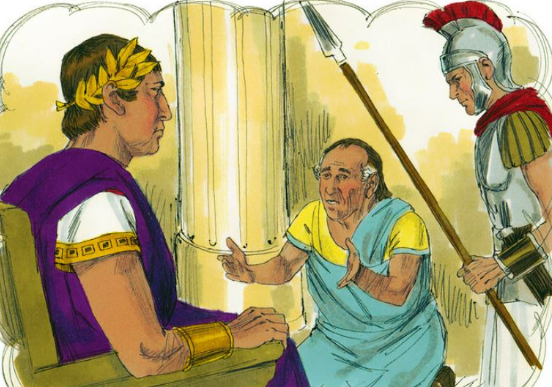
Chapter 9: The Unpayable Debt: The Logic of Forgiveness In The Parable of The Unforgiving Servant (Matthew 18:21-35)
21. Then came Peter to him, and said, Lord, how oft shall my brother sin against me, and I forgive him? till seven times?
22. Jesus saith unto him, I say not unto thee, Until seven times: but, Until seventy times seven.
23. Therefore is the kingdom of heaven likened unto a certain king, which would take account of his servants.
24. And when he had begun to reckon, one was brought unto him, which owed him ten thousand talents.
25. But forasmuch as he had not to pay, his lord commanded him to be sold, and his wife, and children, and all that he had, and payment to be made.
26. The servant therefore fell down, and worshipped him, saying, Lord, have patience with me, and I will pay thee all.
27. Then the lord of that servant was moved with compassion, and loosed him, and forgave him the debt.
28. But the same servant went out, and found one of his fellowservants, which owed him an hundred pence: and he laid hands on him, and took him by the throat, saying, Pay me that thou owest.
29. And his fellowservant fell down at his feet, and besought him, saying, Have patience with me, and I will pay thee all.
30. And he would not: but went and cast him into prison, till he should pay the debt.
31. So when his fellowservants saw what was done, they were very sorry, and came and told unto their lord all that was done.
32. Then his lord, after that he had called him, said unto him, O thou wicked servant, I forgave thee all that debt, because thou desiredst me:
33. Shouldest not thou also have had compassion on thy fellowservant, even as I had pity on thee?
34. And his lord was wroth, and delivered him to the tormentors, till he should pay all that was due unto him.
35. So likewise shall my heavenly Father do also unto you, if ye from your hearts forgive not every one his brother their trespasses.
This parable employs dramatic financial hyperbole to illustrate a core principle of the kingdom: the experience of receiving God's infinite mercy creates a non-negotiable responsibility to extend finite mercy to others. The story's power lies in its stark, mathematical contrast between two debts, a contrast designed to portray unforgiveness not just as immoral, but as an act of spiritual insanity.
9.1 The Context: Peter's Question on Forgiveness
The parable is prompted by a practical question from the Apostle Peter: "Lord, how oft shall my brother sin against me, and I forgive him? till seven times?". In asking this, Peter likely thought he was being generous, as some rabbinic traditions suggested forgiving an offense three times. Jesus's response immediately shatters this legalistic, calculative approach: "I say not unto thee, Until seven times: but, Until seventy times seven". This number, whether translated as 77 or "seventy times seven," is not a new limit to be counted but a symbol for limitless, unending forgiveness. The parable that follows is an extended illustration of why this limitless forgiveness is the only logical posture for a citizen of God's kingdom.
9.2 The Scale of the Two Debts: A Deliberate Hyperbole
The central rhetorical device of the parable is the staggering, almost unimaginable contrast between the two debts.
Debt 1: Ten Thousand Talents. The first servant is brought before his king, owing "ten thousand talents". A single talent was the largest unit of currency in the ancient world, representing a massive weight of silver or gold. Scholars estimate its value as equivalent to at least 15 to 20 years of a common laborer's wages. The number "ten thousand" (myrioi) was the highest numeral in the Greek counting system, often used to mean "innumerable" or "infinite." The debt is therefore an astronomical, hyperbolic sum which is more than the annual tax revenue of a whole province like Galilee. It is a debt on a national scale, utterly and hopelessly impossible for an individual to repay. This figure is carefully chosen to symbolize the infinite, unpayable nature of humanity's sin debt before a holy God.
Debt 2: One Hundred Pence. After being forgiven, the same servant seeks out a fellow servant who owes him "a hundred pence". A penny was the standard wage for one day's labor. The second debt, therefore, amounts to about 100 days' wages which is significant but entirely manageable sum. It represents the finite, comparatively trivial offenses that human beings commit against one another.
The deliberate and extreme disparity between these two amounts is the lynchpin of the entire story.
Table: A Comparison of Debts in the Parable
To fully appreciate the parable's logic, the contrast must be seen in stark terms. The following table visualizes the scale of the two debts, using the conservative estimate of a talent being worth 6,000 pence.
| Feature | Debt Owed to the King | Debt Owed to the Servant |
|---|---|---|
| Amount | 10,000 talents | 100 pence |
| Equivalent in Labor | ~164,383 years of wages | 100 days of wages |
| Repayability | Impossible | Possible, though difficult |
| Symbolizes | Our sin debt to God | Offenses of others against us |
| Ratio | 60,000,000 : 100 or 600,000 : 1 | 1 : 600,000 |
9.3 The King's Mercy and the Servant's Cruelty
Faced with being sold into slavery with his family to begin paying the impossible debt, the servant falls on his knees and begs for patience, making the absurd promise, "Lord, have patience with me, and I will pay thee all". The king, moved "with compassion," does something far more radical than grant an extension. He cancels the entire debt, wiping the slate clean. This act represents the free, total, and unmerited grace of God's forgiveness.
The forgiven servant's subsequent actions are shockingly brutal. He immediately finds his fellow servant, and the text describes his violence: "took him by the throat, saying, Pay me that thou owest". Despite hearing the exact same plea for patience that he himself had just made, he refuses and has the man thrown into a debtor's prison. He withholds a mercy he has just received on an infinitely grander scale.
9.4 The Consequence: Forgiveness Revoked?
When the king learns of the servant's cruelty, his pity turns to wrath. He summons the servant, calling him "wicked," and delivers the parable's central question: "Shouldest not thou also have had compassion on thy fellowservant, even as I had pity on thee?". The logic is one of moral and spiritual reciprocity. The king then reverses his pardon and hands the servant over to be tortured "till he should pay all that was due unto him". Since the debt is unpayable, this implies a sentence of eternal punishment.
Jesus brings the parable to its sharp and unsettling conclusion: "So likewise shall my heavenly Father do also unto you, if ye from your hearts forgive not every one his brother their trespasses". This ending raises difficult theological questions about the security of salvation and whether God's forgiveness can be revoked, a point of considerable debate.
The parable's primary argument is that a persistent state of unforgiveness is not merely a personal failing but a fundamental misunderstanding of the gospel itself. The unforgiving servant acts not just out of malice, but out of a complete failure to grasp the magnitude and meaning of the grace he has received. By choking his debtor over a trivial sum after being forgiven an infinite one, he demonstrates that the king's mercy has had no transformative effect on his heart or his worldview. He still operates within a petty, transactional economy of strict accounting. The parable powerfully suggests that a person who has truly internalized the reality of God's infinite forgiveness cannot logically or spiritually remain in a state of hard-hearted unforgiveness toward others. Therefore, a stubborn refusal to forgive is presented as damning evidence that one has never truly accepted the "cancellation of debt" in the first place, or has retroactively nullified its effect through hypocrisy.
Jesus constructs the argument using the inescapable logic of economics and mathematics to show that unforgiveness is an act of spiritual insanity. The financial hyperbole is so extreme, a ratio of at least 600,000 to 1that the servant's action is not just immoral, it is profoundly irrational. He is willing to forfeit the cancellation of a debt worth a nation's GDP for the sake of collecting a debt worth a few months' wages. Jesus uses the cold, hard language of finance to make a profound spiritual point: when you have been forgiven an infinite debt, holding onto a finite grudge against another is the worst, most self-destructive bargain imaginable. It is a willful act of self-sabotage, choosing to re-enter a system of debt and retribution that will ultimately and justly crush you.
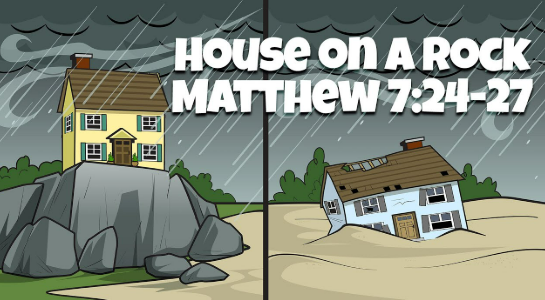
Chapter 10: Hearing & Doing: The Foundational Ethic of The Parable of The Two Builders (Matthew 7:24-27)
24. Therefore whosoever heareth these sayings of mine, and doeth them, I will liken him unto a wise man, which built his house upon a rock:
25. And the rain descended, and the floods came, and the winds blew, and beat upon that house; and it fell not: for it was founded upon a rock.
26. And every one that heareth these sayings of mine, and doeth them not, shall be likened unto a foolish man, which built his house upon the sand:
27. And the rain descended, and the floods came, and the winds blew, and beat upon that house; and it fell: and great was the fall of it.
Positioned as the definitive conclusion to the Sermon on the Mount, the Parable of the Two Builders serves as a powerful and unambiguous summary of Jesus's core ethical demand. It is not a complex allegory but a stark, simple contrast that defines true wisdom and authentic discipleship not as a matter of knowledge, but of obedience.
10.1 Literary Context: The Capstone of the Sermon on the Mount
The parable's placement at the very end of Matthew chapters 5 through 7 is strategically crucial. It functions as the impressive capstone on the entire structure of the Sermon, which is the most extensive collection of Jesus's ethical teachings in the New Testament. The opening phrase, "Therefore whosoever heareth these sayings of mine, and doeth them" explicitly links the parable's lesson to the entire body of teaching that has just been delivered, the Beatitudes, the reinterpretations of the Law, the Lord's Prayer, and the commands regarding anger, lust, forgiveness, anxiety, and judgment. The parable is not a standalone story; it is the final, urgent application of everything that has come before it.
10.2 The Two Foundations: Rock vs. Sand
The parable presents two figures who are, in many respects, identical. Both are builders. Both hear the same words from Jesus. Both construct a house. Both are subjected to the exact same storm. The single variable that determines their ultimate fate is the foundation upon which they build.
The wise builder is defined as one who hears these words of mine and puts them into practice by building his house upon a rock. This active obedience, this integration of teaching into life, constitutes the "rock" foundation. The wise man digs deep, expending effort to ground his life on the solid bedrock of Jesus's commands.
The foolish builder is defined as one who hears these words of mine and does not put them into practice by building his house upon the sand. His failure is not one of hearing or understanding, but of implementation. This inaction, this gap between knowledge and practice, constitutes the "sand" foundation which is an easy, superficial base that requires no real effort.
10.3 The Inevitable Storm: A Test of Foundation
The storm that descends upon both houses is described with threefold intensity: "the rain descended, and the floods came, and the winds blew, and beat upon that house". This imagery represents the inevitable trials and crises that test the integrity of a person's life. Interpretations of the storm vary:
-
Ethical Interpretation: The storm symbolizes the calamities, afflictions, and adversities of life such as persecution, loss, temptation, and hardship that can assault a person's faith and character.
-
Eschatological Interpretation: The storm represents the final, eschatological Day of Judgment, when the true nature of every person's life will be revealed and tested by God.
In either interpretation, the storm's function is the same: it does not test the house's external appearance or size, but only the integrity of its unseen foundation. It is the moment of truth that reveals what a life is truly built upon.
10.4 The Verdict: Obedience as the Sole Measure of Wisdom
The outcomes are absolute and binary. The house built on the rock of obedience "fell not: for it was founded upon a rock". The house built on the sand of mere hearing "it fell: and great was the fall of it.". The parable thus provides a stark and simple definition of spiritual wisdom and folly. Wisdom is not the accumulation of religious knowledge or the ability to articulate theological truths. Wisdom is obedience. Folly is hearing the truth and failing to act on it.
This parable radically redefines the concept of faith for its listeners. The foolish builder is not an atheist, a pagan, or an explicit opponent of Jesus. He is, in fact, part of the audience; he is one who "heareth these sayings of mine". He has all the correct information. He might even intellectually agree with the Sermon on the Mount and admire its ethical beauty. His failure is a failure of praxis. The parable thus serves as a powerful and enduring critique of a purely cognitive, confessional, or passive faith. It argues that the only authentic and durable response to divine revelation is to actively structure one's life upon it. The foundation is not "believing the words" in an abstract sense; it is "doing the words." This makes embodied obedience the very architecture of a resilient spiritual life.
Crucially, the parable emphasizes that the storm is identical for both builders. The same rain, floods, and winds beat against both houses with equal force. This carries a profound theological implication: discipleship offers no exemption from the trials of life. Following Jesus is not a promise of a storm-free existence. On the contrary, it is the promise of a foundation that can withstand the inevitable storms, whether they are the ethical trials and persecutions of this life or the final judgment to come. The parable's focus is not on avoiding hardship but on building a life with the structural integrity to survive it. The choice is not between a life of storms and a life of peace, but between a life that endures the storm and a life that is destroyed by it.
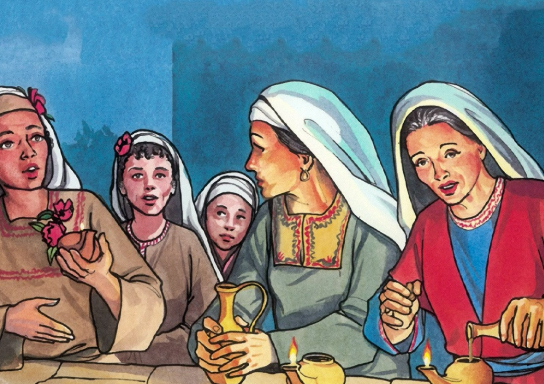
Chapter 11: The Personal Flame: Individual Responsibility In The Parable of The Ten Virgins (Matthew 25:1-13)
- Then shall the kingdom of heaven be likened unto ten virgins, which took their lamps, and went forth to meet the bridegroom.
- And five of them were wise, and five were foolish.
- They that were foolish took their lamps, and took no oil with them:
- But the wise took oil in their vessels with their lamps.
- While the bridegroom tarried, they all slumbered and slept.
- And at midnight there was a cry made, Behold, the bridegroom cometh; go ye out to meet him.
- Then all those virgins arose, and trimmed their lamps.
- And the foolish said unto the wise, Give us of your oil; for our lamps are gone out.
- But the wise answered, saying, Not so; lest there be not enough for us and you: but go ye rather to them that sell, and buy for yourselves.
- And while they went to buy, the bridegroom came; and they that were ready went in with him to the marriage: and the door was shut.
- Afterward came also the other virgins, saying, Lord, Lord, open to us.
- But he answered and said, Verily I say unto you, I know you not.
- Watch therefore, for ye know neither the day nor the hour wherein the Son of man cometh.
This parable, part of the Olivet Discourse concerning the end times, uses the familiar imagery of a first-century wedding to deliver a stark and unsettling message about the nature of spiritual readiness. It argues that preparedness for Christ's return is a matter of personal, non-transferable responsibility that must be cultivated over time.
11.1 The Wedding Customs of First-Century Judea
The parable's narrative is built upon the wedding customs of the time. A Jewish wedding often involved a two-stage process. After the betrothal period, the groom would come, often at an unexpected time and typically at night, to the bride's home. From there, he would lead a joyful procession, accompanied by friends and attendants, to his own home or his father's house for the wedding feast, which could last for several days.
The "ten virgins" (more accurately, young unmarried women or bridesmaids) are attendants of the bride, tasked with waiting for the groom's arrival. Their role was to join the procession, carrying lamps or torches to light the way and to add to the festive atmosphere, symbolizing joy and honor. A delay in the groom's arrival, as depicted in the parable, was a common and realistic feature of these events, often due to last-minute negotiations or pre-wedding festivities.
11.2 The Division: Wise vs. Foolish
The parable introduces ten virgins, all of whom share the same role and initial expectation. All ten take their lamps and go out to wait for the bridegroom. All ten, when faced with the bridegroom's long delay, become drowsy and fall asleep. The fact that they all slept is a critical detail; it shows that the point of failure is not a lack of vigilance in the sense of staying awake, but a lack of foresight.
The sole distinction between the two groups of five is their level of preparation. The "wise" virgins demonstrated foresight by bringing extra flasks of oil along with their lamps. The "foolish" virgins did not; they brought only the oil already in their lamps, making no provision for a potential delay.
11.3 The Crisis and the Refusal to Share
The moment of crisis arrives at midnight with the sudden cry, "Behold, the bridegroom cometh; go ye out to meet him". All ten virgins wake up and trim their lamps. The foolish ones, however, realize with panic that their lamps are sputtering and going out. They turn to the wise and plead, "Give us of your oil; for our lamps are gone out".
The response of the wise virgins is the theological core of the parable. They refuse: "Not so; lest there be not enough for us and you: but go ye rather to them that sell, and buy for yourselves.". This refusal, which on the surface appears selfish and contrary to other teachings on charity, is precisely the point Jesus is making.
11.4 The Theological Meaning of the Oil
The oil in the parable is a metaphor for a state of personal spiritual readiness that cannot be improvised or transferred at the last moment. It symbolizes the inner reality of a person's faith, a cultivated and living relationship with God, the indwelling presence of the Holy Spirit, and a character shaped by ongoing obedience and good deeds. The lamps, in contrast, can be seen as the outward profession of faith, the visible association with the waiting community. The parable teaches that an outward profession (a lamp) is useless in the moment of crisis without the inner substance (the oil) to sustain it.
The wise virgins' refusal to share is not an act of selfishness but a statement of spiritual reality. The oil of a prepared heart, of a life lived in faithfulness, is inherently personal and cannot be given from one person to another.
11.5 The Shut Door: The Finality of Unpreparedness
The conclusion of the parable is stark and final. While the foolish virgins are away on their futile, last-minute quest to acquire what should have been prepared long before, the bridegroom arrives. "the bridegroom came; and they that were ready went in with him to the marriage: and the door was shut".
When the foolish virgins return and plead, "Lord, Lord, open to us." they are met with the devastating and final reply, "Verily I say unto you, I know you not". This is not a statement of ignorance but a formal disavowal, a declaration that no relationship exists. The parable ends with the explicit exhortation that summarizes its entire purpose: "Watch therefore, for ye know neither the day nor the hour wherein the Son of man cometh".
The central lesson of the parable is that spiritual readiness is a non-transferable, personal responsibility. The crucial moment, the refusal of the wise virgins to share their oil would have been jarring in a culture that prized community and mutual support. Jesus leverages this very harshness to make a radical point about the nature of one's relationship with God. The "oil" of a genuine faith, of a character forged over time, of the indwelling Holy Spirit, is fundamentally individual. It cannot be borrowed from a devout spouse, a pious parent, or a faithful pastor in the final hour. The parable stands as a powerful warning against a second-hand or vicarious faith, asserting that while believers exist within a community, their ultimate accountability and readiness before God are matters of individual preparation.
Furthermore, the story distinguishes between two kinds of waiting: passive waiting and prepared waiting. All ten virgins are outwardly engaged in the same activity of waiting, and all ten fall asleep during the delay. For much of the narrative, they are indistinguishable. The parable's crisis, the long delay followed by the sudden midnight arrival that is specifically designed to reveal the crucial difference between two kinds of faith. The foolish virgins possess a faith sufficient for the short term, for the expected and the easy. Their preparation is superficial. The wise virgins, however, possess a faith prepared for the long haul, for the unexpected trial and the midnight crisis. Their preparation is substantive. The parable suggests that true spiritual readiness is not about a single moment of decision but about the continual, diligent maintenance and cultivation of one's inner life, the "extra oil" that equips a person to endure the unforeseen and the arduous journey of faith.
Conclusion
The parables of Jesus, when stripped of centuries of moralizing simplification and examined within their native first-century context, re-emerge as the sharp, disruptive, and profoundly challenging narratives they were intended to be. This analysis has demonstrated that these stories are not comforting fables but sophisticated theological arguments, designed to dismantle the prevailing religious and social structures of their day. They function as invitations into an upside-down kingdom, a reality governed by a divine logic that consistently inverts human expectations.
The overarching themes reveal a coherent and radical vision. In this kingdom, the definition of "neighbour" is exploded to include one's most hated enemy, transforming a legal category into an active command of mercy (The Good Samaritan). Grace is shown to be a scandalous and sovereign gift that offends human notions of fairness and merit, rewarding the eleventh-hour laborer equally with the first (The Workers in the Vineyard). Justification before God is severed from religious performance and granted instead to the humble and self-aware sinner, while the self-righteous are sent away empty (The Pharisee and Tax Collector). The kingdom itself is not a majestic, orderly empire but an invasive, uncontrollable force that spreads like a weed, disrupting the cultivated gardens of human power (The Mustard Seed).
These narratives consistently challenge the comfortable and the powerful. They expose the spiritual bankruptcy of a works-based righteousness that breeds resentment and an inability to rejoice in grace (The Prodigal Son's Older Brother). They reveal that a distorted, fear-based view of God's character leads to a paralyzed and fruitless faith (The Talents). They teach that receiving God's infinite forgiveness creates an inescapable imperative to extend finite forgiveness to others, and that to refuse is to fundamentally misunderstand the gospel (The Unforgiving Servant).
Ultimately, the parables are a call to a discipleship that is active, personal, and transformative. Authentic faith is not merely hearing Jesus's words but building one's entire life upon the foundation of obedience (The Two Builders). Spiritual readiness is a non-transferable responsibility, a personal flame that must be continually maintained and cannot be borrowed at the final hour (The Ten Virgins). And entry into the kingdom, while offered freely to all, requires an inner transformation, a willingness to shed one's own righteousness and be clothed in the grace provided by the King (The Wedding Banquet). Even the final judgment is reframed, with the glorious King revealing that he is hidden within the vulnerable and the needy, making our response to human suffering our ultimate response to him (The Sheep and Goats).
When read with historical and theological integrity, the parables cease to be relics of a bygone era. They become living, dynamic tools for critique, challenging modern assumptions about religion, justice, and community. They compel the contemporary reader to ask the same unsettling questions they posed to their first audience: Who is the "Samaritan" I am called to love? Am I the "older brother" standing outside the feast of grace? Is my faith a solid foundation or shifting sand? By confronting us with these questions, the parables continue their work of shattering our self-made worlds and inviting us into the strange, gracious, and demanding economy of the upside-down kingdom of God.
Also see: